
How precision sprocket chains maintain registration accuracy in offset presses, flexographic printers, corrugators, and paper converting equipment — where even 0.1 mm drift means scrap.
Why Printing Is the Ultimate Test of Chain Precision
Printing and paper converting equipment demands the highest positional accuracy of any chain-driven industrial application. A four-color offset press requires all four impression cylinders to align their images within 0.1 mm of each other — any misregistration produces visible color fringing, ghosting, or banding that renders the printed sheet unacceptable. The chain drives that synchronize these cylinders must maintain this accuracy at speeds above 10,000 impressions per hour, hour after hour, day after day.
This combination of extreme precision and sustained high speed makes printing the most technically demanding market segment for sprocket chain manufacturers. Chains for printing presses are ground to pitch tolerances of 0.03% or better, heat-treated for dimensional stability, and pre-stretched to eliminate initial elongation during break-in. Only a handful of global manufacturers consistently produce chains at this quality level.
Chain Drives in Offset and Flexographic Printing
| Application | Registration Requirement | Pitch Tolerance | Typical Chain |
|---|---|---|---|
| Sheet-Fed Offset Press | ± 0.05 mm | 0.03% | ANSI 25 / 35 Precision |
| Web Offset Press | ± 0.1 mm | 0.03% | ANSI 35 / 40 Precision |
| Flexographic Printer | ± 0.15 mm | 0.05% | ANSI 35 / 40 Precision |
| Corrugator Drive | ± 0.5 mm | 0.10% | ANSI 50 / 60 Standard+ |
| Folder/Gluer | ± 0.3 mm | 0.05% | ANSI 35 / 40 Precision |
| Die Cutter | ± 0.2 mm | 0.05% | ANSI 40 / 50 Precision |
| Registration requirements are typical values. Specific press models may have tighter or looser tolerances. Consult the press manufacturer. | |||
Offset printing presses use gear trains for the primary impression cylinder synchronization, but chain drives are used extensively for sheet transport, delivery systems, inking roller drives, and dampening systems. These secondary drives still require pitch accuracy within 0.03-0.05% because any speed variation in the ink or dampening system produces banding — alternating light and dark strips across the printed image.
Flexographic presses use chain drives more extensively than offset presses, including for impression cylinder drives on some models. The registration tolerance for flexographic printing (typically 0.15 mm) is slightly more forgiving than offset, but the trend toward higher-quality flexographic output on flexible packaging is tightening these requirements. Pre-stretched precision chains with documented pitch accuracy certificates are becoming standard specification for new flexographic press installations.
Corrugators and Paper Converting Equipment
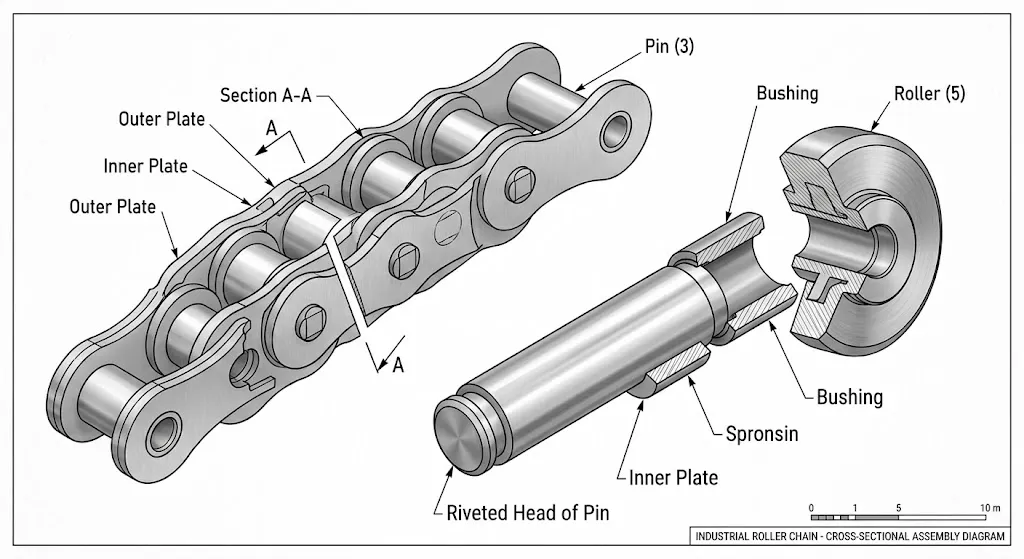
Corrugating machines operate at sheet speeds above 300 meters per minute, and the chain drives that synchronize the corrugating rolls, pre-heaters, and bridge section must keep pace without introducing speed variations that cause paper wrinkling or delamination. The registration requirements are less demanding than printing (0.5 mm rather than 0.1 mm), but the sustained high speed and heavy loads from wide-web paper handling demand robust chains in ANSI 50 to ANSI 60 pitch with standard-plus accuracy.
Paper converting equipment — folder-gluers, die cutters, laminators, and slitter-rewinders — uses chains to drive feed rollers, folding mechanisms, and rotary dies. Folder-gluers require precision chains because the fold position determines the finished carton dimensions; a fold placed 0.3 mm off-center produces a carton that will not erect properly on the packaging line. Die cutters need consistent chain speed to align cut patterns with printed graphics on pre-printed board.
Pre-Stretched Chains and Dimensional Stability
Precision chains for printing applications are pre-stretched during manufacturing — the chain is loaded to 30-50% of its rated ultimate tensile strength for a controlled duration, permanently seating the pins in their bushings and eliminating the initial elongation (typically 0.2-0.5%) that standard chains undergo during break-in. The result is a chain that maintains its pitch accuracy from the first revolution, without the positional drift that would cause registration errors during the critical break-in period.
Pre-stretching also improves dimensional uniformity along the chain length. In a standard chain, pitch varies slightly from link to link due to manufacturing tolerances. Pre-stretching equalizes these variations by yielding the tighter links preferentially, producing a more uniform pitch across the entire chain. This uniformity is what enables the sub-0.05% pitch accuracy that printing presses require.
Maintenance Without Disrupting Registration
Printing press chain maintenance is complicated by the fact that any chain adjustment or replacement may affect registration settings that took hours to optimize. The maintenance protocol must preserve registration wherever possible: lubricate without removing chains, measure elongation in-situ, and replace chains only during scheduled press maintenance when full re-registration is already planned.
When chain replacement is necessary, install the new chain and run the press at slow speed through all registration adjustment procedures before returning to production speed. Document the sprocket positions (mark the reference tooth on each sprocket) so that if a chain is removed for inspection, it can be reinstalled in exactly the same position. This attention to detail prevents the hours of re-registration work that an undocumented chain replacement would require.
Why Choose Hangzhou Ever-Power as Your Supplier
Selecting a sprocket chain supplier is a decision that extends far beyond unit price. Delivery reliability, dimensional consistency across production batches, willingness to support OEM customization, and responsive after-sales technical backing all factor into the total cost of ownership. Hangzhou Ever-Power Sprocket Chain Co., Ltd. has built its reputation over decades by treating each of these factors as a baseline expectation rather than a premium add-on.
From raw steel blanking through heat treatment, shot peening, and final assembly, every production stage happens under one roof in Hangzhou — eliminating the quality drift that plagues multi-vendor supply chains.
Non-standard bore sizes, special tooth profiles, proprietary surface coatings, and unique attachment configurations are routine production orders — not special projects that require months of back-and-forth negotiation.
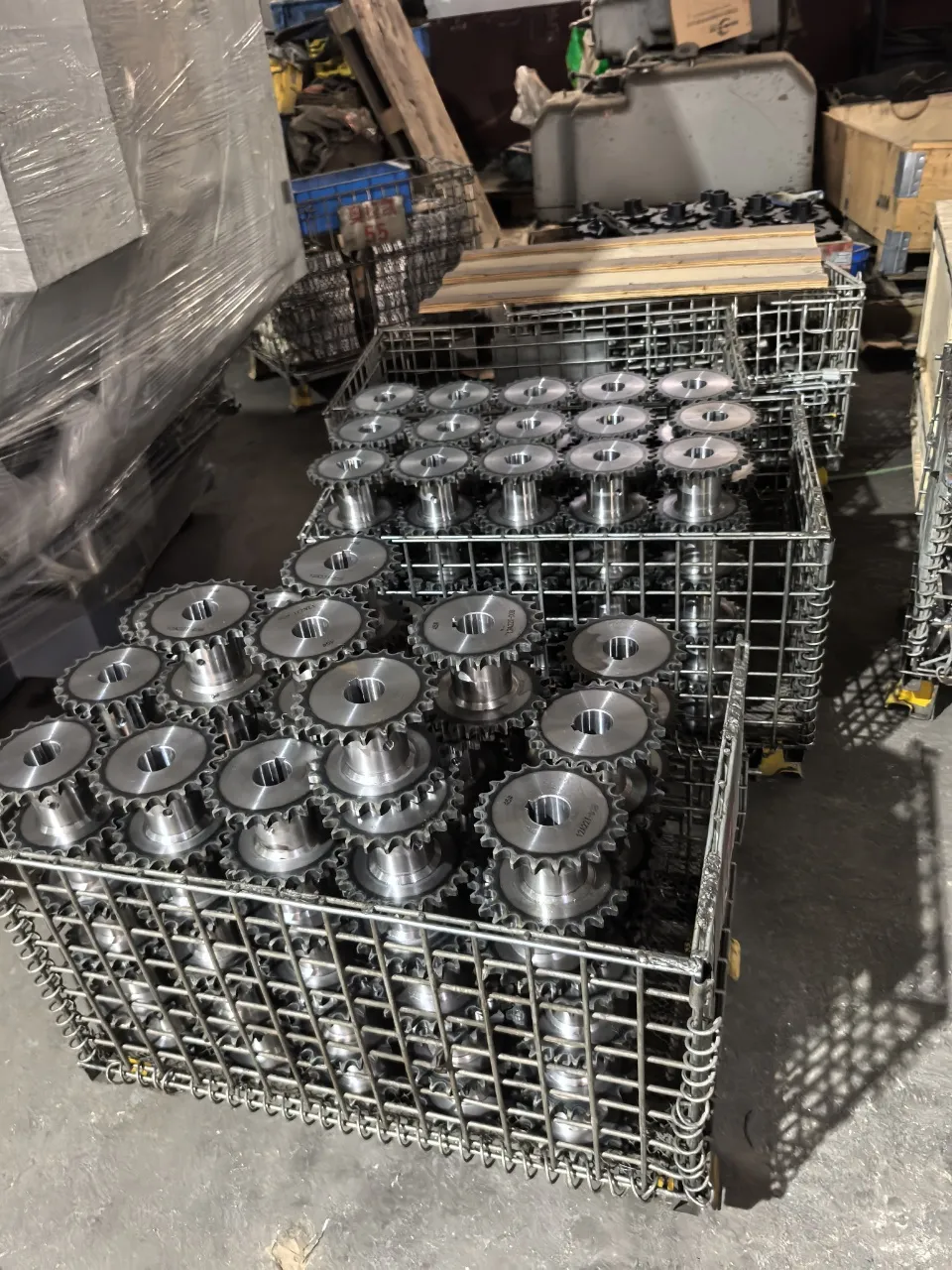
Every batch undergoes tensile testing, Rockwell hardness verification, dimensional inspection with CMM equipment, and pre-shipment elongation checks before products leave the factory floor.
Products ship to over 60 countries with packaging rated for ocean freight and documentation compliant with EU, North American, and Southeast Asian import regulations.
Frequently Asked Questions
Get in Touch with Our Engineering Team
Whether you need a standard catalog chain or a fully custom-engineered solution, our technical sales team is ready to assist with specification, pricing, and logistics.
Company
Hangzhou Ever-Power Sprocket Chain Co., Ltd.
Address
Shenhua Road, Hangzhou, China
Phone
+86-571-88220653