Description
Double Pitch Stainless Steel
Sprockets SUS2040SB
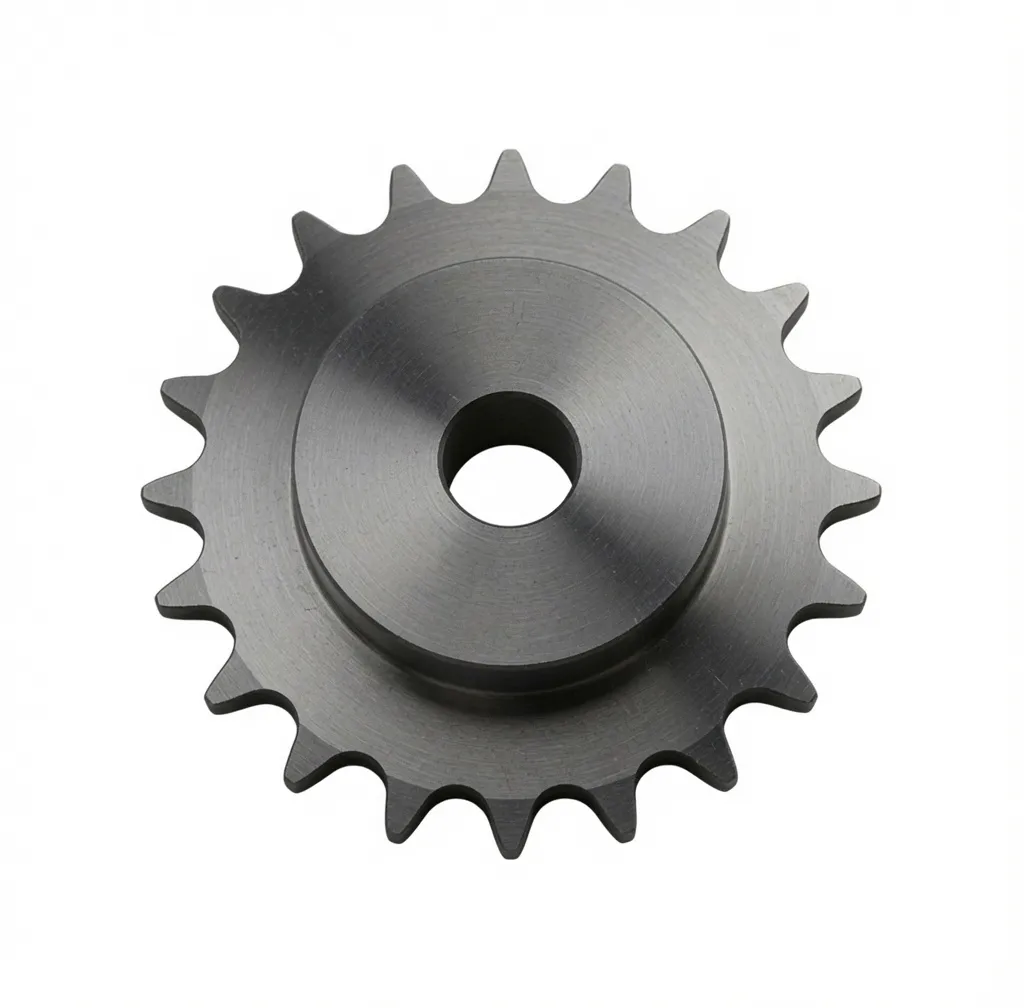
Small-roller double-pitch stainless sprockets for No.2040S conveyor chain — combining the low-weight, long-centre advantages of double-pitch drive design with full 304 stainless corrosion resistance.
What Is the SUS2040SB Double-Pitch Stainless Sprocket?
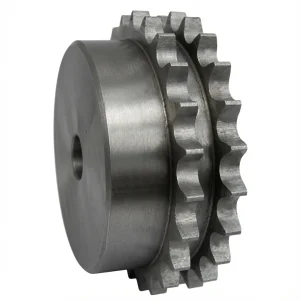
The SUS2040SB is a double pitch conveyor chain sprocket manufactured from 304 stainless steel, designed to drive No.2040S chain — a double-pitch chain derived from the standard No.40 roller chain family. In this designation, “2040” identifies the chain series (double the 40-series pitch), while “S” indicates the small-roller variant and “B” denotes the sprocket design type. The pitch of No.2040S chain is 25.4 mm — exactly double the 12.7 mm standard pitch of the No.40 chain — and the roller diameter remains the same as the standard chain at 7.95 mm. This means the SUS2040SB sprocket has the same tooth geometry as an SUS40B at the same effective position count, but operates at the longer double-pitch chain spacing.
The fundamental reason to specify double-pitch chain and sprockets over the standard equivalent is the weight and cost advantage on long conveyor runs. When chain spans tens or hundreds of metres — as is common in food processing transport conveyors, packaging line transfers, and industrial material handling systems — the cost of the chain itself becomes a major project cost driver. Double-pitch chain is roughly 30–40% lighter and less expensive per unit length than the equivalent standard-pitch chain for the same working load capacity, making it the economically preferred choice for long, lightly loaded horizontal conveyors where the reduced pitch density is not a performance compromise.
The SUS designation confirms 304 austenitic stainless throughout. All the hygiene and corrosion resistance benefits of the stainless SUS series apply to the SUS2040SB: self-passivating surface, FDA-compatible material, non-magnetic character, and full tolerance of industrial washdown chemicals. This makes the SUS2040SB the natural choice for food processing, pharmaceutical, and chemical plant conveyor drives where stainless construction is a specification requirement rather than an option.
Understanding Double-Pitch Chain: SB vs RB Design Types
Double-pitch roller chains in the 2040-series family come in two roller variants that require correspondingly different sprocket designs. Understanding the distinction is essential for correct specification — an SB sprocket will not correctly engage RB chain and vice versa, because the tooth root radius geometry differs between the two types.
| Parameter | SUS2040SB (SB / Small Roller) | SUS2040RB (RB / Large Roller) |
|---|---|---|
| Chain designation | No.2040S | No.2040R |
| Chain pitch | 25.4 mm | 25.4 mm |
| Roller diameter | 7.95 mm (small) | 15.88 mm (large) |
| Effective tooth counts | 9½ / 10½ / 11½ / 12½ | 10 / 11 / 12 / 13 |
| Tooth width (T) | 7.2 mm | 7.2 mm |
| Relative load capacity | Standard | Higher |
Chain Parameters & Dimensional Specifications
The No.2040S chain uses the double pitch of 25.4 mm with the same roller diameter (7.95 mm) and inner link width (7.95 mm) as the standard No.40 chain. This means the SUS2040SB tooth profile is geometrically identical to a standard SUS40B sprocket tooth — only the pitch circle diameter changes because the tooth spacing along the chain is 25.4 mm rather than 12.7 mm. The “effective teeth number” (effected teeth No.) is expressed as a half-integer because the alternating-link engagement of a double-pitch chain on an SB sprocket means that a 9½-tooth sprocket engages alternating rollers across 19 chain half-pitches.
SUS2040SB Dimensional Table — 4 Standard Sizes
Effective tooth count expressed as half-integer per JIS B1801 double-pitch convention. All dimensions in millimeters; weight in kilograms.
| Type | Eff. Teeth | OD Do (mm) | PCD Dp (mm) | Stock Bore | Min. Bore | Max. Bore | Hub BD | Hub BL | Wt. (kg) |
|---|---|---|---|---|---|---|---|---|---|
| SUS2040SB | 9½ | 84 | 78.23 | 13 | 15 | 38 | 60 | 25 | 0.64 |
| SUS2040SB | 10½ | 92 | 86.17 | 13 | 15 | 46 | 69 | 25 | 0.93 |
| SUS2040SB | 11½ | 99 | 94.15 | 13 | 15 | 51 | 77 | 25 | 0.99 |
| SUS2040SB | 12½ | 108 | 102.14 | 13 | 15 | 42 | 63 | 25 | 1.06 |
Why Double-Pitch Chain? Engineering Advantages Explained
Double-pitch chain is not simply a larger version of standard chain — it is a different design solution that offers genuine engineering and cost advantages in specific applications. The SUS2040SB conveyor sprocket wheel is the stainless steel component that enables these advantages in corrosive or hygiene-sensitive environments. Understanding why double-pitch is chosen clarifies when the SUS2040SB is the correct specification and when a standard SUS40B is the better fit.
304 Stainless Steel in Conveyor Drive Environments
The decision to specify stainless steel for a double-pitch conveyor drive follows the same logic as for any stainless chain component: the operating environment imposes conditions that carbon steel cannot survive at the required service interval without protective coating maintenance. Conveyor systems in food, pharmaceutical, and chemical production are prime examples — these systems run multi-shift operations in environments where washdown chemicals, process moisture, and hygiene audit requirements make carbon steel an impractical material choice for any component that contacts or is adjacent to product streams.
For the SUS2040SB specifically, the 304 stainless construction adds no geometric complexity over its carbon steel equivalent — the tooth form, bore dimensions, and hub geometry are identical. What the stainless material provides is operational continuity: the ability to run through washdown cycles without rust formation, to tolerate the caustic detergent concentrations used in food-grade cleaning protocols, and to pass the surface material compliance checks that HACCP, BRC, and similar food safety schemes apply to all equipment that can contact or contaminate food products.
CIP Washdown Tolerant
Tolerates NaOH (2–4%) and HNO₃ (1–2%) CIP cleaning cycles without surface attack or rust formation. Self-passivating surface recovers after each acid rinse phase.
Non-Particle-Shedding
304 stainless does not shed rust particles or coating fragments into the product stream. Critical for food, pharma, and cosmetics production where contamination triggers product recalls.
Regulatory Compliance
304 stainless is accepted under FDA, EU 1935/2004, and 3-A Sanitary Standards for food-contact equipment. EN 10204 3.1 material certificates available for regulated procurement categories.
Industry Applications of SUS2040SB
Double-pitch stainless sprockets in the SUS2040SB class are installed wherever long conveyor runs, lower chain weight, and full corrosion resistance are simultaneously required. The following sectors represent the primary demand base for this product.
Food Processing Transport Conveyors
Transfer conveyors in fruit and vegetable washing lines, meat processing transport systems, and bottling plant infeed conveyors typically span 15–50 metres at low speeds. Double-pitch stainless chain with SUS2040SB sprockets reduces chain cost and mass on these long runs while meeting the full food-grade hygiene requirements of facilities certified to FSSC 22000 or BRC Food Safety standards.
Packaging Machinery Product Transport
The longer pitch of double-pitch chain naturally suits the product spacing requirements of packaging machinery infeed and outfeed conveyors, where products are carried at regular intervals by attachments on the chain. SUS2040SB sprockets drive these attachment chains in food-zone packaging machinery where the stainless requirement applies to all moving components in the product area.
Pharmaceutical Production Line Conveyors
GMP-regulated tablet and capsule conveyor systems use stainless chain drives throughout the production environment. Double-pitch stainless chain with SUS2040SB sprockets is used on the longer inter-station transfer conveyors between processing units, where reducing chain weight and cost is beneficial and the load requirements are within the double-pitch chain’s rated capacity.
Light Industrial Assembly & Sorting Lines
Parts washing line conveyors, electroplating line transport systems, and light-load sorting conveyors in industrial manufacturing environments use double-pitch stainless chain to reduce the chain cost and maintenance burden on conveyors that must operate in humid, solvent-laden, or chemically active factory atmospheres. The SUS2040SB sprocket meets both the drive geometry requirement and the corrosion resistance requirement in a single component.
Manufacturing Precision for Double-Pitch Geometry
The half-integer effective tooth count of SB-type double-pitch sprockets requires careful attention during hobbing setup. While the tooth profile geometry matches the standard SUS40B tooth form, the pitch circle diameter for a 9½-tooth sprocket is calculated using the fractional tooth count in the PCD formula — meaning the hob and blank rotation synchronization must be set to generate the correct tooth spacing for the fractional count rather than defaulting to the nearest integer tooth count setting. Our CNC hobbing systems are programmed with the correct fractional-count parameters for each SUS2040SB size, ensuring the pitch circle diameter matches the catalogue specification exactly.
⚙️ Fractional-Count Hobbing Setup
CNC hobbing programs are configured with precise fractional tooth-count parameters (9.5, 10.5, 11.5, 12.5) for each SUS2040SB size. This ensures the pitch circle diameter and tooth spacing match catalogue specifications, not the nearest integer tooth count that would be used by mistake if setup parameters were not specifically programmed for double-pitch SB geometry.
📐 PCD Verification at First-Off
The first part at each tooth count and each production run is measured by CMM for pitch circle diameter and tooth spacing before production continues. The PCD tolerance is held to ±0.05 mm. Parts outside this tolerance are returned to hobbing for correction before any further production proceeds.
🔩 Bore & Keyway Per Standard
Bores are reamed to H7 tolerance (Ra ≤ 0.8 μm). Keyways broached to DIN 6885 as standard. Set-screw tapping and custom keyway profiles on request. Hub dimensions follow the catalogue table for each effective tooth count. All bore work completed after hobbing to avoid distortion from the hobbing clamping operation.
Why Choose Hangzhou Ever-Power for Double-Pitch Stainless Sprockets
Correctly producing SB-type double-pitch sprockets requires specific process knowledge — not every sprocket manufacturer programs their hobbing equipment for fractional tooth counts. As a stainless steel sprocket specialist with complete in-house production, we handle the SUS2040SB range with the same dimensional discipline applied across all our stainless sprocket families.
Dedicated hobbing programs for each SB effective tooth count are maintained in our CNC library, ensuring every production run generates the correct PCD rather than rounding to the nearest integer.
Every SUS2040SB part is measured for pitch circle diameter, bore, and hub runout before dispatch. Dimensional records are archived per batch for quality traceability.
Single-piece sample orders accepted. Conveyor designers can validate SUS2040SB fit and engagement quality on a physical prototype before committing to full production quantity. No tooling charge for catalogue bore configurations.
EN 10204 3.1 material certificates on request. Full export documentation — commercial invoice, packing list, COO — prepared in-house in English for all international shipments.
How to Order
For SUS2040SB, specify the effective tooth count (9½, 10½, 11½, or 12½), required bore diameter, and quantity. Keyway, set-screw, and custom bore requests are handled as standard operations. Contact us at [email protected] or +86-571-88220653. More information at our contact page.
Frequently Asked Questions
Common questions about SUS2040SB double-pitch stainless sprockets.