A clear technical comparison between sprockets and gears — covering working principles, advantages, cost factors, and application guidelines to help engineers select the right power transmission method.
Defining the Two Systems
A sprocket is a toothed wheel designed to engage with a chain. It transfers rotational motion through the chain to another sprocket on a remote shaft, using the chain as a flexible connecting link. A gear, by contrast, is a toothed wheel that engages directly with another gear through interlocking teeth — no intermediate link is needed. Both components convert and transmit rotational power, but they do so through fundamentally different mechanisms, and each mechanism carries distinct advantages and limitations.
The confusion between sprockets and gears arises because they look similar at a glance — both are round, both have teeth, and both mount on shafts. However, the tooth profiles are entirely different. Sprocket teeth are shaped to cradle chain rollers with a curved seat at the root and straight flanks. Gear teeth follow involute profiles optimized for smooth rolling contact between two meshing gears. Installing a chain on a gear, or meshing two sprockets directly, would destroy both components within minutes.
Key Differences in Working Principle
Sprocket Chain vs Gear Drive — Feature Comparison
| Feature | Sprocket + Chain | Gear Drive |
|---|---|---|
| Center Distance | 500 mm to 5,000+ mm | Contact mesh — very short |
| Speed Ratio Range | 1:1 to 10:1 (single stage) | 1:1 to 6:1 per stage |
| Efficiency | 95 – 98% | 98 – 99% |
| Shock Absorption | Moderate (chain elasticity) | Low (rigid mesh) |
| Noise Level | Medium to high | Low to medium (helical) |
| Maintenance | Lubrication + tension adjustment | Sealed gearbox — minimal |
| Cost (initial) | Lower for long center distances | Lower for compact layouts |
| Alignment Tolerance | Moderate | Tight (gear mesh critical) |
| Comparison assumes standard industrial applications. Specialized variants (silent chain, planetary gears) shift specific parameters. | ||
The chain drive sprocket system works through positive engagement — each roller seats in a tooth gap, and the chain acts as a flexible series of links connecting two or more sprockets across a distance. The chain can absorb moderate shock loads because the links flex slightly at the joints, distributing transient forces over several teeth rather than concentrating them at a single mesh point. This flexibility also allows for slight misalignment and thermal expansion without catastrophic failure.
A gear drive transfers force through direct tooth-to-tooth contact. The involute tooth profile ensures that as one gear rotates, the contact point slides smoothly along the mating tooth surface, maintaining a constant velocity ratio. Gear drives are more efficient because there is no intermediate link — energy only passes through one contact interface instead of two (chain-to-driver sprocket and chain-to-driven sprocket). However, gear drives demand precise center distance and parallel shaft alignment; even small deviations cause accelerated tooth wear, noise, and vibration.
When to Choose a Sprocket and Chain System
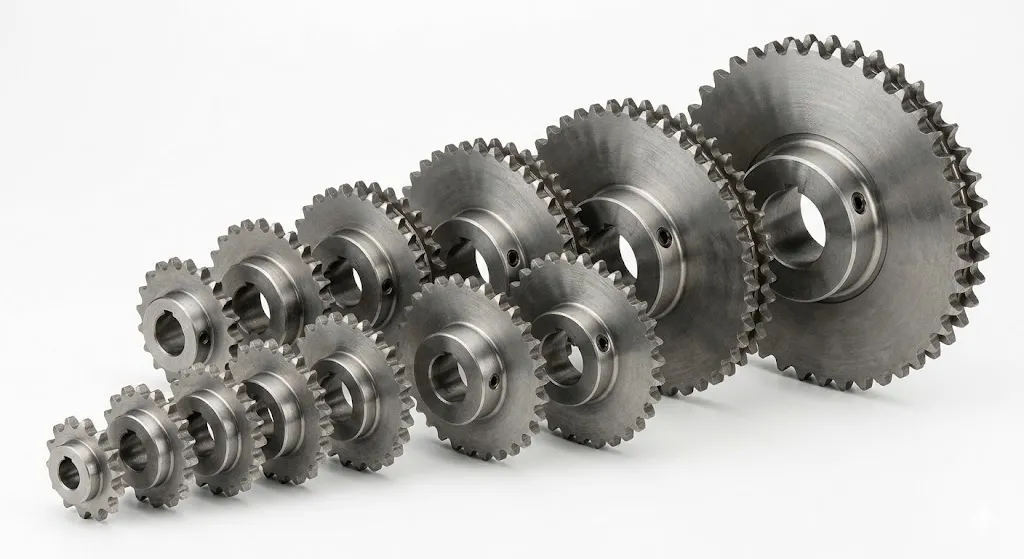
Sprocket and chain drives excel in applications where the driving and driven shafts are separated by a significant distance — typically 500 mm or more — and where a gear train would require multiple intermediate stages, each adding cost, complexity, and efficiency loss. They are the default choice for conveyors, agricultural equipment, motorcycle drivetrains, and industrial machines where the motor and driven component cannot be placed side by side.
Chains also tolerate dirtier environments better than precision gear meshes. In a cement plant or sawmill, airborne particulate that would destroy an open gear mesh is merely an inconvenience for a chain drive if the chain is properly lubricated and periodically cleaned. The ability to adjust center distance by adding or removing links is another practical advantage — relocating a motor or adjusting a conveyor length does not require a new set of custom gears, just a different chain length.
When to Choose a Gear Drive
Gears are the better choice when efficiency, compactness, and low noise are the primary requirements. A helical gear set operating in a sealed gearbox can achieve 99% efficiency per stage, runs nearly silently, and requires virtually no maintenance beyond periodic oil changes. Applications that demand precise speed synchronization — such as machine tool spindles, printing presses, and timing drives — favor gears because the rigid mesh eliminates the slight velocity variation (chordal action) inherent in chain-and-sprocket systems.
For very high-speed drives above 3,000 RPM, gears are almost always preferable because chain drives at these speeds generate excessive noise, vibration, and centrifugal force on the chain. Similarly, applications requiring very high reduction ratios (above 10:1) are more practical with multi-stage gearboxes than with a single-stage chain drive that would need a very small driver sprocket and a very large driven sprocket.
Cost Comparison Across Application Types
For long center distances, chain drives are significantly cheaper to implement than gear drives. A chain and two sprockets spanning a 2-meter distance costs a fraction of the multi-stage gear train plus intermediate shafts, bearings, and housings needed to cover the same span. However, chain drives incur higher lifetime maintenance costs — lubrication, tension adjustment, and periodic replacement — that gear drives in sealed housings avoid.
For compact, high-speed, high-ratio applications, gearboxes offer lower total cost of ownership despite higher initial purchase price. The reduction in maintenance labor, the elimination of chain and sprocket replacement cycles, and the higher energy efficiency compound into substantial savings over the equipment’s 15- to 20-year operating life. Engineers should evaluate both initial procurement cost and projected lifetime operating cost before finalizing the drive type.
Why Choose Hangzhou Ever-Power as Your Supplier
Selecting a sprocket chain supplier is a decision that extends far beyond unit price. Delivery reliability, dimensional consistency across production batches, willingness to support OEM customization, and responsive after-sales technical backing all factor into the total cost of ownership. Hangzhou Ever-Power Sprocket Chain Co., Ltd. has built its reputation over decades by treating each of these factors as a baseline expectation rather than a premium add-on.
From raw steel blanking through heat treatment, shot peening, and final assembly, every production stage happens under one roof in Hangzhou — eliminating the quality drift that plagues multi-vendor supply chains.
Non-standard bore sizes, special tooth profiles, proprietary surface coatings, and unique attachment configurations are routine production orders — not special projects that require months of back-and-forth negotiation.
Every batch undergoes tensile testing, Rockwell hardness verification, dimensional inspection with CMM equipment, and pre-shipment elongation checks before products leave the factory floor.
Products ship to over 60 countries with packaging rated for ocean freight and documentation compliant with EU, North American, and Southeast Asian import regulations.
Frequently Asked Questions
Get in Touch with Our Engineering Team
Whether you need a standard catalog chain or a fully custom-engineered solution, our technical sales team is ready to assist with specification, pricing, and logistics.
Company
Hangzhou Ever-Power Sprocket Chain Co., Ltd.
Address
Shenhua Road, Hangzhou, China
Phone
+86-571-88220653