Understand chain pitch — the single dimension that determines sprocket compatibility, load capacity, and system performance — with practical guidance on selecting the right pitch for your application.
What Is Chain Pitch and Why It Is the Defining Dimension
Chain pitch is the distance from the center of one pin to the center of the adjacent pin in the same chain strand. It is the single most important dimension in a roller chain because it determines which sprocket the chain can engage, the load capacity per strand, the maximum operating speed, and the overall size of the drive system. Every other chain dimension — roller diameter, inner width, pin diameter, plate thickness — is scaled proportionally to the pitch. Changing the pitch changes everything.
The term pitch applies identically to both the chain and the sprocket. The sprocket tooth spacing must match the chain pitch exactly for proper engagement. If the chain pitch and sprocket pitch differ by even 0.2 mm, the rollers will ride incorrectly in the tooth gaps, causing uneven load distribution, accelerated wear on both components, and eventually chain derailment under dynamic loading conditions.
The ANSI and ISO Pitch Series
ANSI Roller Chain Pitch Progression
ANSI B29.1 defines pitch sizes in increments of eighths of an inch, starting at #25 (6.35 mm) and progressing through #35, #40, #50, #60, #80, #100, #120, #140, #160, #200, and #240 (76.2 mm). The chain number divided by 8 gives the pitch in inches — ANSI 80 has a pitch of 80/8 = 1 inch = 25.4 mm. ISO 606 uses a parallel series designated by B-suffix numbers, with slightly different roller diameters and inner widths at most pitch sizes.
The most commonly used pitches in general industrial applications are ANSI 40 (12.7 mm), ANSI 50 (15.875 mm), ANSI 60 (19.05 mm), and ANSI 80 (25.4 mm). Together, these four sizes account for the majority of power transmission chain sold globally. Smaller pitches serve precision drives and high-speed applications; larger pitches handle heavy loads in mining, steel, and cement industries.
How Pitch Affects Load Capacity
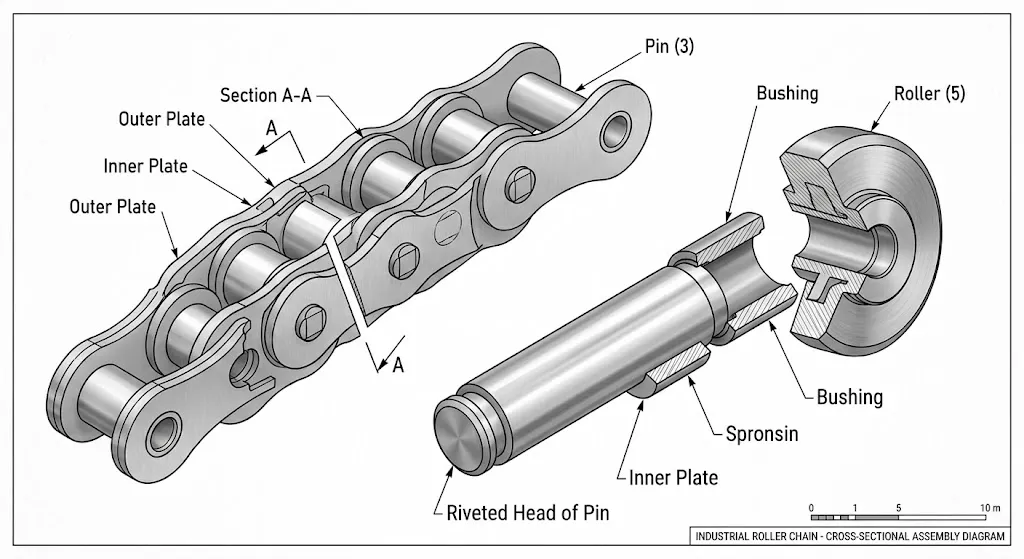
Tensile strength increases exponentially with pitch because all component dimensions scale with pitch size. An ANSI 40 chain (12.7 mm) has a minimum ultimate tensile strength of approximately 17.8 kN per strand. An ANSI 80 chain (25.4 mm) — double the pitch — has a tensile strength of approximately 71.2 kN, which is four times higher, not merely double. This non-linear relationship means that moving to the next larger pitch provides a disproportionately large increase in load capacity.
However, larger pitch also means heavier chain, larger sprockets, higher centrifugal forces at speed, and more pronounced chordal action. The engineering optimization is to select the smallest pitch that comfortably meets the load requirement with an appropriate service factor. This minimizes weight, cost, vibration, and sprocket diameter while providing adequate strength and fatigue life.
How Pitch Affects Speed and Noise
Chain speed capability decreases with increasing pitch. The polygon effect — the cyclic speed variation caused by the chain wrapping around the sprocket as a series of straight chords rather than a smooth arc — produces impacts as each roller engages and disengages the sprocket tooth. At higher speeds, these impacts occur more frequently and with greater force, generating noise and vibration that limit the practical maximum RPM. An ANSI 25 chain on a 25-tooth sprocket can run at 6,000+ RPM; an ANSI 80 chain on the same tooth count is typically limited to 800 RPM.
For applications requiring both high speed and high load, the solution is multi-strand chains at a smaller pitch rather than a single-strand chain at a larger pitch. A triplex ANSI 50 chain provides approximately the same load capacity as a simplex ANSI 80 chain, but the smaller pitch allows significantly higher operating speeds with lower noise and vibration.
Selecting the Right Pitch for Your Application
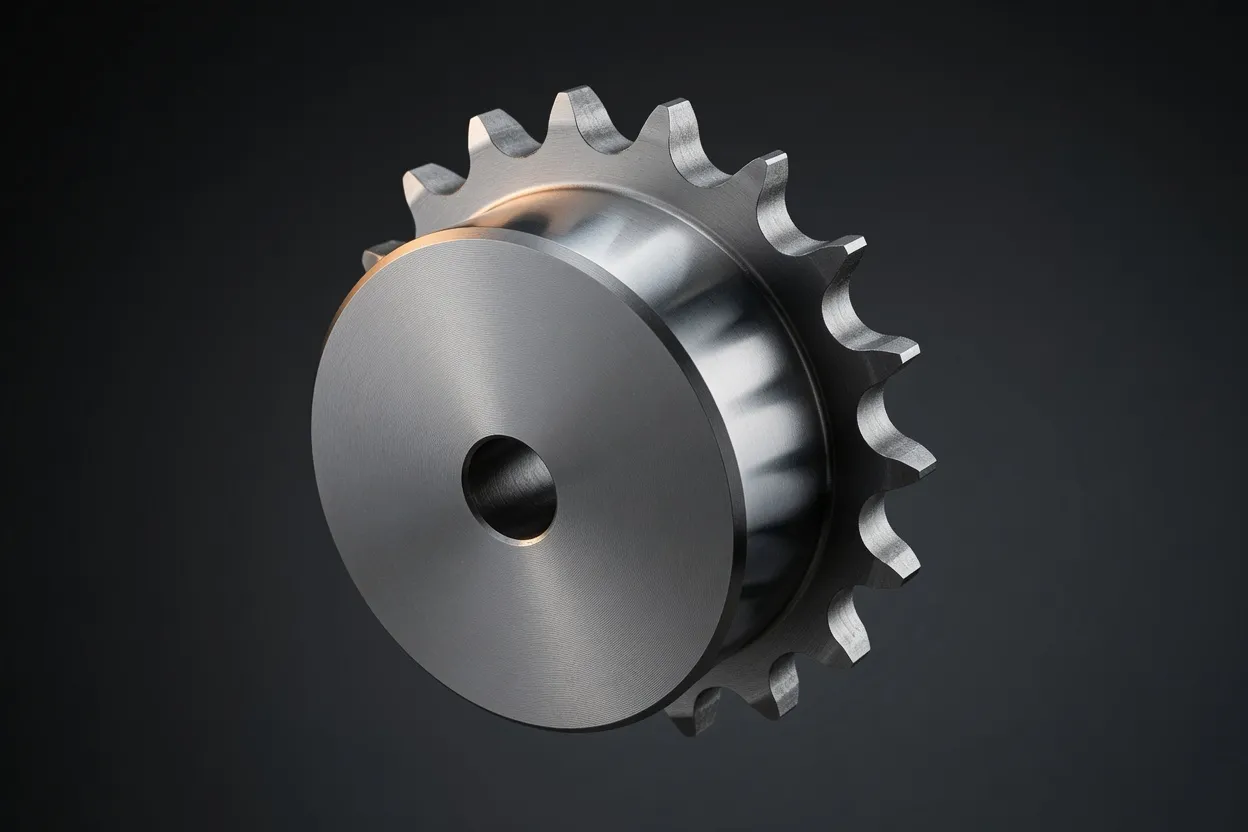
Start with the required power transmission — multiply the driven torque by the shaft RPM to get power in watts. Consult the chain manufacturer’s power rating table, which lists maximum transmittable power for each pitch at various sprocket speeds and tooth counts. Identify the smallest pitch where the rated power exceeds your required power multiplied by the service factor. If the resulting driven sprocket has more than 120 teeth, consider a smaller pitch with multi-strand configuration or a two-stage drive arrangement.
For conveyor applications where power is low but chain length is long, double pitch chains (twice the standard pitch, same roller diameter) offer a cost-effective alternative. They reduce the number of links and pins per meter while maintaining the same tooth engagement characteristics on special double-pitch sprockets. This configuration lowers both initial cost and weight for light-duty, long-distance conveyor runs.
Why Choose Hangzhou Ever-Power as Your Supplier
Selecting a sprocket chain supplier is a decision that extends far beyond unit price. Delivery reliability, dimensional consistency across production batches, willingness to support OEM customization, and responsive after-sales technical backing all factor into the total cost of ownership. Hangzhou Ever-Power Sprocket Chain Co., Ltd. has built its reputation over decades by treating each of these factors as a baseline expectation rather than a premium add-on.
From raw steel blanking through heat treatment, shot peening, and final assembly, every production stage happens under one roof in Hangzhou — eliminating the quality drift that plagues multi-vendor supply chains.
Non-standard bore sizes, special tooth profiles, proprietary surface coatings, and unique attachment configurations are routine production orders — not special projects that require months of back-and-forth negotiation.
Every batch undergoes tensile testing, Rockwell hardness verification, dimensional inspection with CMM equipment, and pre-shipment elongation checks before products leave the factory floor.
Products ship to over 60 countries with packaging rated for ocean freight and documentation compliant with EU, North American, and Southeast Asian import regulations.
Frequently Asked Questions
Get in Touch with Our Engineering Team
Whether you need a standard catalog chain or a fully custom-engineered solution, our technical sales team is ready to assist with specification, pricing, and logistics.
Company
Hangzhou Ever-Power Sprocket Chain Co., Ltd.
Address
Shenhua Road, Hangzhou, China
Phone
+86-571-88220653