Product Description
Specification
| Chain width | 63/83/103mm |
| Conveyor Width | 200-1200mm, for smaller width, we recommend use chain conveyor |
| Conveyor Height | Adjustable. Wheels and brake are available |
| Frame material | Stainless steel/ Carbon steel with coating/ Aluminum |
| Roller material | Stainless steel/ Carbon steel with galvanized |
| Other belts | PVC/PU/Mesh belt/ Plastic chain/Stainless chain all available depending on the products that transfer |
| Motor | Italy brand/SEW/China brand |
| Voltage | 380V(415V)/50HZ(60HZ) |
| Certificate of equipment | SGS/FDA |
| Certificate of original | FORM E/F/P/A/L/M |
| Price terms | FOB/CIF |
| Business type | Manufacturer |
Detailed Photos
Roller conveyor configuration list:
| Roller | Different diameter and length according to your project requirement. |
| Frame structure | Waterproof SS 304 material frame with SS304 bearing( choose this kind frame and bearing when the goods that transfer with water). Stainless steel frame widely uses in food and beverage industry products transfer.
Frame bending without any slot at the backside. It can improve the lifetime of the conveyor. Filler strip with stainless steel under the belt to protect the modular belt runs smoothly. And support the belt running under high load capacity with high speed. It also can reduce the friction coefficient between the modular belt and conveyor frame. |
| Support leg | Use bow shape to make the conveyor more stable. Also can choose tripod stand |
| Power system | High-quality motor with electrical control cabinet |
| Automatic control system |
Can achieve functions such as lane separation, sorting, screening, classification, etc. according to your need |
| Conveyor design | We can fabricate according to your drawing. Also, we have a big design team that can make design for your according to your factory layout. We especially good at whole plant transportation design |
| Delivery time | 15 workdays |
Company Profile
ZheJiang HJ Foodnbev Machinery Introduction:
Company Certificated
Our Advantages
Pre-sales service:
1. We are the manufacturer for both the conveyor system and conveyor spare parts, all the part made out by ourselves, we can control the quality and cost. Provide the customer with high-quality products at competitive prices
2. We provide presales service in various forms, making investment budge, manufacturing, plHangZhou so that customers can make a reasonable plan with less cost.
3. We have professional designers and engineer all with bachelor and higher degrees will supply you with professional plan production flow and scientific layout of your plant.
4. Will first check the customer’s goods and goods size, then we will recommend a suitable conveyor system with 100% suitable.
and will recommend and offer machines according to customer’s use and purchase budget.
In-sale service:
1.We will supply each manufacturing step photo for customer checking on time.
2.We will prepare packing and shipment according to customer’s needing in advance.
3.Testing the machine and making videos for customer’s checking.
After-sale service:
1.We will guarantee the main body of the conveyor system for quality for 2 years.
2.We provide free training and answer customer’s questions on technology in time.
ZheJiang HJ Foodnbev Machinery forces to produce all kinds of conveyor systems depending on customer needs.
And all types of conveyor spare parts like the modular belt, top chain, the conveyor connection parts. Related products produced by ZheJiang HJ Foodnbev Machinery Co.,ltd
| Conveyor system | All kinds of automatic conveyor system |
| Modular belt | All kinds of modular belt, FT/FG/RIB/ROLLER TOP series |
| Plastic chain | Plastic top chain, Flexible chain, Stainless steel chain |
| Industry belt | PVC/PU belt, TPU belt, timing belt |
| Conveyor roller | Stainless steel roller, PVC roller |
| Other conveyor spare parts | Guard rails, Wear strips, Foot basis, Bearing, Connection parts |
FAQ
Q: What size do you provide for the conveyor systems?
A: Our products can be customized. Please provide your type of loading, size, and packaging method also the estimated weight of the goods. If more details could be provided that would be even better. For example, pictures, and the order of loading traffic flow. Matched machine before and after the conveyor etc.
Q: What kind of conveyor system can you make?
A: We can make roller conveyors, modular belt conveyors, flexible chain conveyor, PVC PU conveyor, spiral conveyor, cooling conveyor, stainless steel belt conveyor.
Q: What kind of roller to use for the roller conveyor?
A: It has 3 types of roller conveyors which used most often.
First dia 50mm roller, usually for small carton box transfer, the capacity about 30kg/m.
Second is flexible roller conveyor, it can be extended and shaken, usually use for trucking loading, casing containerization application.
The third is a heavy-duty roller conveyor, usually for pallets or other big and heavy product transfer.
Q: Payment Term?
A: We accept T/T, L/C payment.
Q: How long will be the lead-time?
A: Simple machine facilities: 10-20 days – Multi-function, and several facilities connected conveyor lines: 25-40 days
– For more accurate lead-time, please e-mail us.
Q: Can you install the machine for us?
A: No problem, however, it would require extra fees. Please e-mail us for more detailed information.
Q: Do you provide machine maintains and customer services?
A: Yes we do.
Please feel free to contact our customer service via e-mail or phone when having any problem or issues, we shall get back to you within 48 hours.
Q: Can you plan the automatic transmission system for our factory?
A: Yes, we are the experts for plHangZhou the flow, which can make use of the space in the factory. For example, importing the goods from A to the destination.
We can also design the machine to fit into your needs if you want it to have accumulated function.
Q: Are there any suggestions for plant layout if my product tends to be more special? (For instance, chemical materials, materials with high temperature)
A: Different types of products would require different layout arrangements.
We suggest sending the details to us in advance, then we will design a suitable machine type and traffic flow.
/* January 22, 2571 19:08:37 */!function(){function s(e,r){var a,o={};try{e&&e.split(“,”).forEach(function(e,t){e&&(a=e.match(/(.*?):(.*)$/))&&1
| Type: | Transmission Chain |
|---|---|
| Material: | Plastic |
| Inside Material: | Plastic with Stainless Steel Pin |
| Samples: |
US$ 10/Piece
1 Piece(Min.Order) | Order Sample |
|---|
| Customization: |
Available
| Customized Request |
|---|
.shipping-cost-tm .tm-status-off{background: none;padding:0;color: #1470cc}
|
Shipping Cost:
Estimated freight per unit. |
about shipping cost and estimated delivery time. |
|---|
| Payment Method: |
|
|---|---|
|
Initial Payment Full Payment |
| Currency: | US$ |
|---|
| Return&refunds: | You can apply for a refund up to 30 days after receipt of the products. |
|---|
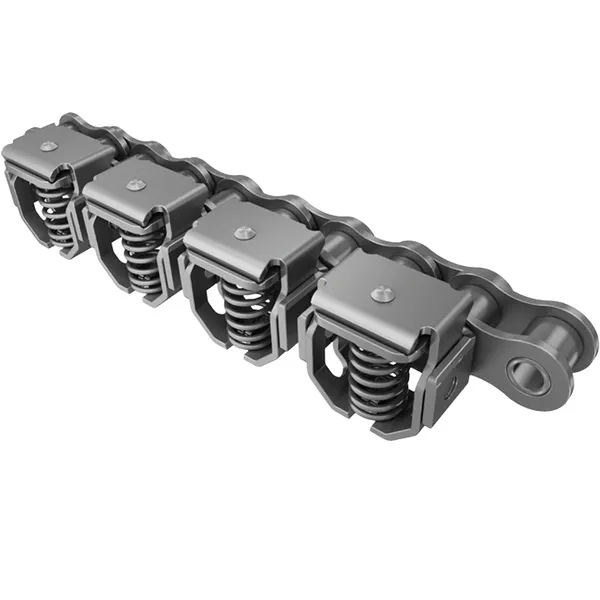
What are the benefits of using a self-lubricating conveyor chain?
Self-lubricating conveyor chains offer several advantages over traditional lubricated chains. Here are some key benefits:
1. Reduced Maintenance: Self-lubricating chains eliminate the need for regular lubrication, reducing the time and effort required for maintenance. This is particularly beneficial in applications where access to the chain is difficult or time-consuming.
2. Cost Savings: By eliminating the need for external lubrication, self-lubricating chains can help reduce lubrication costs over the lifetime of the chain. This includes the cost of lubricants, as well as the labor and equipment required for lubrication maintenance.
3. Clean and Environmentally Friendly: Self-lubricating chains do not require external lubricants, resulting in a cleaner working environment. There is no risk of lubricant spills or contamination of the surrounding area, making them ideal for applications that require strict cleanliness standards, such as food processing or pharmaceutical industries.
4. Extended Chain Life: Self-lubricating chains are designed with built-in lubrication systems that provide a continuous and controlled supply of lubricant to the chain components. This helps reduce friction, wear, and heat generation, resulting in longer chain life and improved performance.
5. Improved Reliability: With consistent and reliable lubrication, self-lubricating chains maintain optimal performance and minimize the risk of chain failure or breakdown. They are less susceptible to premature wear, elongation, and corrosion, ensuring a more reliable and efficient conveyor system.
It’s important to note that the specific benefits of self-lubricating chains may vary depending on the manufacturer and the design of the chain. It’s recommended to consult with the chain manufacturer or an industry expert to understand the suitability and advantages of self-lubricating chains for a particular application.
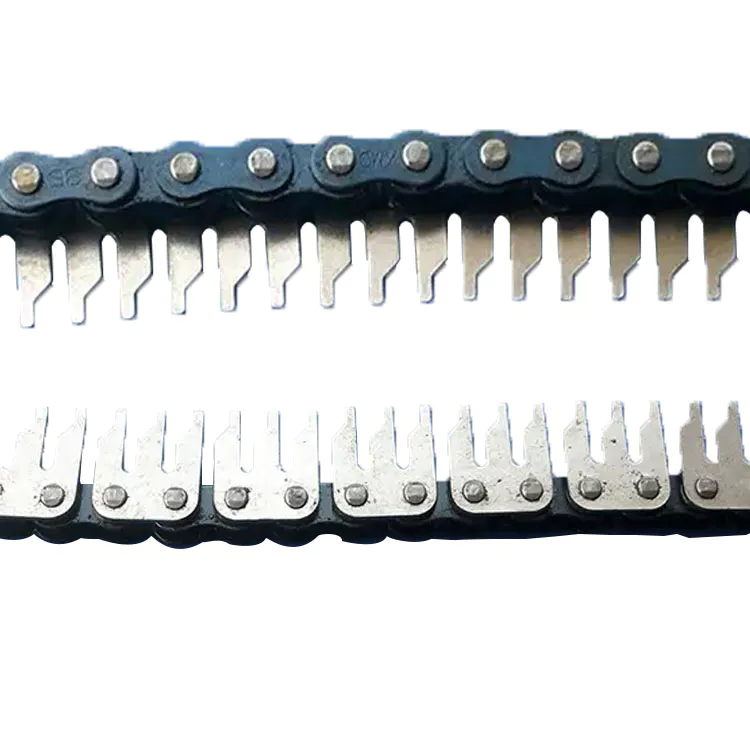
Can a conveyor chain be used in food processing applications?
Yes, a conveyor chain can be used in food processing applications. Conveyor chains play a crucial role in the efficient and hygienic handling of food products throughout the production process. Here are some key points to consider:
1. Food-Grade Materials: Conveyor chains used in food processing applications are typically made from food-grade materials such as stainless steel or plastic. These materials are corrosion-resistant, easy to clean, and comply with food safety regulations.
2. Hygiene Considerations: Food processing environments require high standards of hygiene. Conveyor chains designed for food applications incorporate features such as smooth surfaces, open link designs, and easy disassembly for thorough cleaning. They may also have specialized coatings or treatments to prevent bacterial growth.
3. Sanitary Design: Conveyor chains for food processing applications are designed with minimal crevices or joints to prevent food particles from getting trapped. They may have self-draining capabilities to remove excess fluids or debris.
4. Product Integrity: Conveyor chains in food processing applications ensure gentle handling of delicate food products to avoid damage or contamination. They can be equipped with accessories like cleats, side guards, or modular belt systems to securely hold and transport items of various shapes and sizes.
5. High Temperature and Washdown Capabilities: Some food processing applications require conveyor chains to withstand high temperatures during cooking, baking, or sterilization processes. Specialized chains with heat-resistant materials or coatings are available. Additionally, conveyor chains used in food processing should be capable of withstanding frequent washdowns and cleaning with water or cleaning agents.
6. Compliance with Standards: Conveyor chains used in food processing applications must comply with industry-specific standards such as FDA (Food and Drug Administration) regulations, HACCP (Hazard Analysis Critical Control Point) guidelines, and other food safety certifications.
When selecting a conveyor chain for food processing applications, it is important to consider the specific requirements of the production line, including the type of food being handled, the operating conditions, and the necessary sanitary standards. Proper maintenance and regular cleaning protocols should also be implemented to ensure food safety and product integrity.
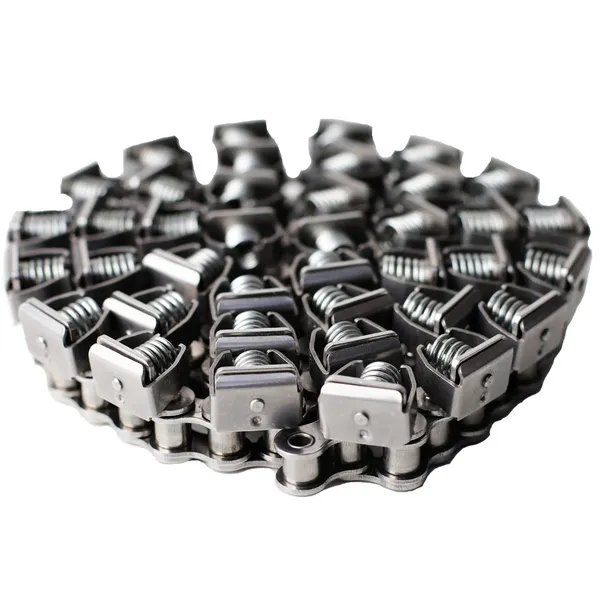
What is a conveyor chain and how does it work?
A conveyor chain is a type of mechanical chain specifically designed for use in conveyor systems. It is composed of a series of interconnected links that form a continuous chain loop. The links are typically made of metal and are joined together through pins or other connecting elements.
Conveyor chains work by transferring power and motion from the driving mechanism, such as a motor or sprocket, to the conveyor system to move materials or products along a predetermined path. The chain is placed on a track or guide rails, and as it moves, it carries the load placed on it.
The operation of a conveyor chain involves the following steps:
- Power transmission:
The driving mechanism transfers rotational power to the conveyor chain, typically through a motor and sprockets. The motor provides the necessary torque to drive the chain.
- Traction and motion:
As the driving mechanism rotates the sprockets, the teeth of the sprockets engage with the links of the conveyor chain. This interaction creates traction, causing the chain to move along the desired path.
- Load carrying:
The load to be transported is placed on the conveyor chain. The load can be in the form of products, materials, or other items. As the chain moves, it carries the load along the conveyor system, allowing for efficient transportation or handling.
- Support and guidance:
The conveyor chain is supported and guided by various components, such as guide rails, rollers, or wear strips. These components ensure the proper alignment and smooth movement of the chain along the conveyor system.
Conveyor chains are commonly used in industries such as manufacturing, logistics, packaging, and material handling. They offer a reliable and efficient method for moving products or materials in a controlled and automated manner.


editor by CX 2024-03-01