Product Description
Detailed Photos
Product Description
| Item Name | Standrad transmission Roller Chains | Model | Series A, Series B |
| Row | Simplex Duplex Triplrex |
Application | Machinery Parts |
| Suiface Treament | netural/sand-blasted/shot-peening | Certification | ISO, ANSI, DIN, BS |
| Packing | Packaged in boxes and wooden cases, or packaged in reels and then on pallets | Port | Any sea port or airport in china |
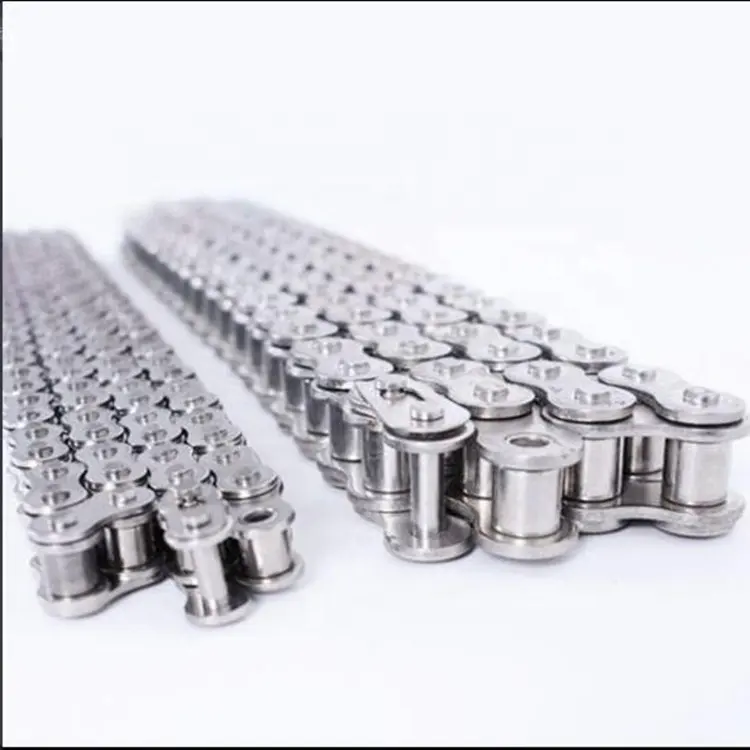
Standard roller chains are a type of industrial chain that is commonly used in power transmission
applications. They consist of a series of cylindrical rollers that are linked together by side plates.
The rollers rotate within the links, transmitting power from 1 sprocket to another.
Standard roller chains are available in a range of sizes and configurations to fit different industrial
applications. They are made from high-quality materials, such as carbon steel or stainless steel,
which are resistant to wear, corrosion, and fatigue.
These chains are designed to provide smooth and efficient power transmission, with minimal energy
loss. They have a high load-bearing capacity, making them suitable for use in heavy-duty machinery,
such as conveyors, elevators, and industrial equipment.
Standard roller chains are also easy to install and maintain, with simple lubrication requirements to
ensure long-lasting performance. Overall, they offer a reliable and cost-effective solution for power
transmission in a wide range of industrial applications.
Other Products
Company Profile
Packaging & Shipping
After Sales Service
/* January 22, 2571 19:08:37 */!function(){function s(e,r){var a,o={};try{e&&e.split(“,”).forEach(function(e,t){e&&(a=e.match(/(.*?):(.*)$/))&&1
| Standard or Nonstandard: | Standard |
|---|---|
| Application: | Textile Machinery, Garment Machinery, Conveyer Equipment, Packaging Machinery, Electric Cars, Motorcycle, Food Machinery, Mining Equipment, Agricultural Machinery |
| Surface Treatment: | Netural/Sand-Blasted/Shot-Peening |
| Material: | Carbon Steel |
| Type: | Short Pitch Chain |
| Surface: | Shot Peening, Black, Blue or Original |
| Samples: |
US$ 1.28/Meter
1 Meter(Min.Order) | |
|---|
| Customization: |
Available
| Customized Request |
|---|
What are the benefits of using a maintenance-free transmission chain?
Using a maintenance-free transmission chain offers several advantages in terms of convenience, cost savings, and overall performance. Here’s a detailed explanation:
1. Reduced Maintenance Requirements: Maintenance-free transmission chains are designed to operate without the need for regular lubrication or additional maintenance tasks. This eliminates the time and effort typically associated with lubrication and inspection schedules, reducing overall maintenance requirements and associated costs.
2. Increased Operational Efficiency: Maintenance-free chains often incorporate specialized self-lubricating materials or coatings that provide excellent lubrication properties over an extended period. This helps to reduce friction, wear, and power losses, resulting in improved operational efficiency. The reduced friction also contributes to lower energy consumption and increased power transmission efficiency.
3. Extended Chain Life: Maintenance-free transmission chains are engineered to have a longer service life compared to traditional lubricated chains. The use of self-lubricating materials or coatings helps to minimize wear, corrosion, and elongation, ensuring the chain remains in optimal condition for an extended period. This leads to reduced downtime, fewer chain replacements, and lower replacement costs.
4. Clean and Environmentally Friendly: Maintenance-free chains do not require external lubrication, which means there is no need for oil or grease application. This results in a cleaner and more environmentally friendly working environment, as there is no risk of oil contamination or leakage. Additionally, maintenance-free chains often generate less noise due to reduced friction, contributing to a quieter working environment.
5. Application Versatility: Maintenance-free transmission chains are available in various types and sizes, making them suitable for a wide range of applications. They can be used in industries such as packaging, food processing, automotive, material handling, and many others where reliability, cleanliness, and reduced maintenance are essential.
It’s important to note that while maintenance-free transmission chains offer numerous benefits, they may not be suitable for all applications. Factors such as load capacity, operating conditions, and environmental factors should be considered when determining the appropriate chain type. Consulting with chain manufacturers or industry experts will ensure the selection of a maintenance-free transmission chain that best meets the specific application requirements.
What are the benefits of using a high-strength transmission chain?
Using a high-strength transmission chain offers several advantages in various applications. Here’s a detailed answer to the question:
1. Increased Load Capacity: A high-strength transmission chain is designed to withstand higher loads and transmit greater amounts of power. It provides enhanced load-carrying capabilities, making it suitable for applications that require heavy-duty operation.
2. Improved Durability: High-strength transmission chains are constructed using high-quality materials and advanced manufacturing processes. This results in superior durability, increased resistance to wear, and improved resistance to fatigue failure. It ensures that the chain can withstand demanding operating conditions and extended service life.
3. Enhanced Safety: The use of a high-strength transmission chain enhances safety in applications where there is a high load or the potential for sudden dynamic forces. It reduces the risk of chain failure, breakage, or unexpected downtime, minimizing the chances of accidents and ensuring a reliable and secure power transmission system.
4. Compact Design: High-strength transmission chains offer a higher strength-to-size ratio, allowing for a more compact and lightweight design compared to standard chains. This can be beneficial in applications with limited space or weight restrictions.
5. Increased Efficiency: High-strength transmission chains typically have lower friction losses, resulting in improved overall system efficiency. The reduced friction ensures efficient power transfer, minimizes energy waste, and contributes to cost savings.
6. Versatile Application: High-strength transmission chains can be utilized in a wide range of industries and applications, including automotive, manufacturing, mining, construction, and more. Their versatility makes them suitable for various power transmission systems.
7. Customization Options: Manufacturers offer a range of high-strength transmission chains with different sizes, pitches, and configurations. This allows for customization based on specific application requirements, ensuring optimal performance and reliability.
When considering the use of a high-strength transmission chain, it is crucial to assess the application’s load requirements, operating conditions, and environmental factors. Consulting with a knowledgeable supplier or engineer can help in selecting the most appropriate chain for the intended application.

What are the common industries or applications that use transmission chains?
Transmission chains are widely used in various industries and applications where the efficient transfer of power and motion is required. Here are some common industries and applications that rely on transmission chains:
- Automotive: Transmission chains are used in automobile engines and drivetrains to transfer power from the engine to the wheels.
- Agriculture: Transmission chains are utilized in agricultural machinery such as tractors, combines, and harvesters for power transmission in various applications like conveyor systems and agricultural equipment.
- Industrial Manufacturing: Transmission chains are found in a wide range of industrial machinery, including conveyors, material handling systems, packaging equipment, printing presses, and machine tools.
- Mining and Construction: Transmission chains are used in heavy machinery, such as excavators, bulldozers, and mining equipment, to transmit power for digging, lifting, and other operations.
- Food and Beverage: Transmission chains are employed in food processing equipment, bottling plants, and conveyor systems to move products along production lines.
- Textile: Transmission chains are utilized in textile manufacturing machinery, such as looms and spinning machines, for power transmission during the weaving and spinning processes.
- Energy and Utilities: Transmission chains are used in power generation plants, wind turbines, and other renewable energy systems for transmitting power from the source to the electrical grid.
- Material Handling: Transmission chains are commonly used in material handling equipment, including forklifts, palletizers, and automated storage systems, to transport and handle goods in warehouses and distribution centers.
- Marine: Transmission chains find applications in marine vessels, such as ship propulsion systems, anchor handling equipment, and winches for cargo handling.
These are just a few examples, and transmission chains are also utilized in various other industries and applications where reliable power transmission is essential. The specific design and characteristics of the transmission chains may vary based on the requirements of each industry and application.


editor by CX 2024-04-12