Product Description
ISO 9001 Approved Agricultural Chain
Why choose us ?
1. HangZhou Xihu (West Lake) Dis.hua Chain Group Co., Ltd established in 1991, we have 5 subsidiaries in china and also have 6 subsidiaries abroad;
2. we covering a production area of 200,100 square meters, have more than 1,800 sets of advanced equipment and over 3,100 highly skilled employees, the annual production capacity has exceeded 20,000,000 meters;
3. we specialized in producing all kinds of standard chains and special chains, such as A or B series chains, drive chains, conveyor chains, drag chains, agricultural chains, sprockets, gears and so on;
4. we have obtained ISO9001, ISO14001, ISO16969, AAA and API certificates.
5. Our partners among world top enterprises, such as JOHNDEERE, NEW HOLLAND, CLAAS, HONDA, KUBOTA, YANMAR, etc.
Our agricultural chains are as following items:
1. SH series high strength heavy duty short pitch roller chains
2. SP series high strength heavy duty short pitch roller chains
3. Walking tractor chains
4. Combine chains
5. ZGS38 combine chain with attachments
6. Rice harvester chains
7. Various agricultural chain with attachments
8. S type steel agricultural chains
9. S type steel agricultural chain with attachments
10. A Type steel agricultural chains
11. CA type steel agricultural chains
12. C type steel agricultural chain with attachments
13. Special agricultural chain with attachments
1) Related Products
2) Certificates
HangZhou Xihu (West Lake) Dis.hua Chain Group Co., Ltd was founded in 1 9 9 1, and now it has five wholly owned subsidiaries, one in ZheJiang province, other four in HangZhou, ZHangZhoug province, it is a professional manufacturer of chains, sprockets, tooth gears and various power transmission products.
The group has XIHU (WEST LAKE) DIS.HUA, ZIQIANG brands, is focused on producing all variety of standard roller chains and special chains, such as conveyor chain, stainless steel chain, agricultural chain. With Xihu (West Lake) Dis.hua brand registered in more than 70 countries like America, Europe, Japan, it is building long term cooperation with these world top enterprises, such as JOHNDEERE, NEW HOLLAND, CLAAS, HONDA, KUBOTA, YANMAR.
There is a technical center of province level, Xihu (West Lake) Dis.hua academician working station, experiment station for Xihu (West Lake) Dis.hua post doctors, and national hundreds of program set up in Xihu (West Lake) Dis.hua group. With these platforms and strong technical ability, the more than hundreds of Engineers and technicians have developed all variety of special high precise and high strength products, conducted mold programs for key components in the car and national industry revitalizing program.
Great attention has been paid on environmental protection and energy saving. The product well displays environmental protection and energy saving. In the year of 2 0 0 0, Xihu (West Lake) Dis.hua took the lead in gaining I S O 1 4 0 0 1 environment management certificate and thereafter passed the inspection of clean production and recycling economy, winning the title of “ZHangZhoug Green Enterprise”.
“We are always serving our customers with our best products.”
/* January 22, 2571 19:08:37 */!function(){function s(e,r){var a,o={};try{e&&e.split(“,”).forEach(function(e,t){e&&(a=e.match(/(.*?):(.*)$/))&&1
| Usage: | Transmission Chain |
|---|---|
| Material: | Alloy/Carbon Steel |
| Surface Treatment: | Oil Blooming |
| Feature: | Heat Resistant |
| Chain Size: | 1/2"*11/128" |
| Structure: | Roller Chain |
| Customization: |
Available
| Customized Request |
|---|

Can transmission chains be used in cleanroom or food processing environments?
Yes, transmission chains can be used in cleanroom or food processing environments, but certain considerations need to be taken into account to ensure compliance with hygiene and cleanliness standards. Here’s a detailed answer to the question:
In cleanroom or food processing environments, maintaining strict hygiene and preventing contamination is crucial. Transmission chains used in such environments must meet specific requirements to ensure safe and sanitary operations. Here are some key considerations:
1. Material Selection: Transmission chains used in cleanroom or food processing environments should be made from materials that are resistant to corrosion, chemicals, and food residues. Stainless steel chains are commonly preferred due to their excellent corrosion resistance and hygienic properties.
2. Design: The design of the transmission chain should minimize crevices, dead spaces, and other areas where contaminants can accumulate. Smooth surfaces and rounded edges are preferred to facilitate easy cleaning and prevent the buildup of debris.
3. Lubrication: In cleanroom or food processing environments, it is essential to use food-grade lubricants or self-lubricating chains that do not contaminate the products or the surrounding environment. These lubricants should be suitable for incidental food contact and meet relevant food safety standards.
4. Cleaning and Maintenance: Regular cleaning and maintenance procedures should be established to keep the transmission chains clean and free from contaminants. This may involve using approved cleaning agents and following proper cleaning protocols to ensure effective removal of any residues or contaminants.
5. Compliance with Regulations: Cleanroom and food processing environments are subject to specific regulations and standards, such as FDA regulations, HACCP principles, or GMP guidelines. It is essential to ensure that the transmission chains used comply with these regulations and meet the necessary certifications or approvals.
By selecting transmission chains specifically designed for cleanroom or food processing applications and following proper cleaning and maintenance procedures, it is possible to use transmission chains in these environments without compromising hygiene and safety. Working closely with suppliers or manufacturers experienced in providing solutions for cleanroom or food processing applications can help ensure the right chain selection and adherence to the required standards.
Can transmission chains be used in power transmission systems?
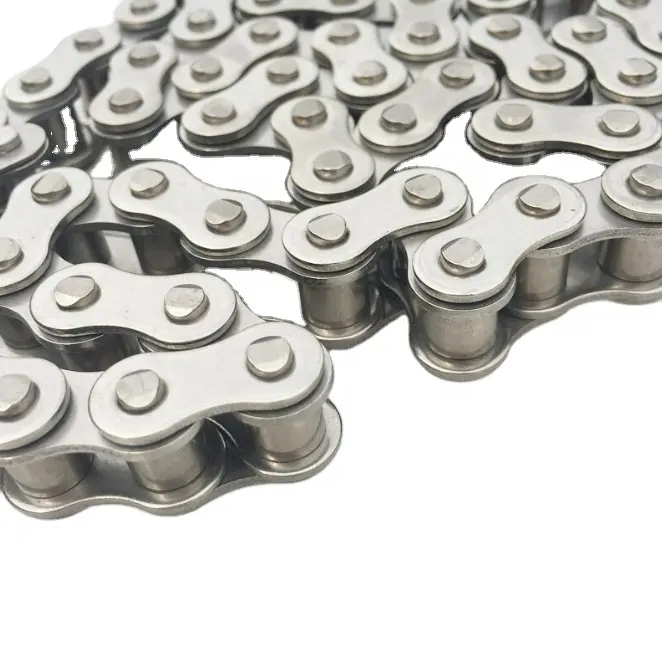
Yes, transmission chains can be used in power transmission systems. Here’s a detailed answer to the question:
Transmission chains are commonly employed in various power transmission applications where the transfer of mechanical power is required. These chains are designed to transmit rotational motion and power from one shaft to another.
Transmission chains are used in a wide range of power transmission systems, including:
- Industrial Machinery: Transmission chains are used in machinery such as conveyor systems, packaging equipment, printing presses, and machine tools to transfer power and motion between different components.
- Agricultural Equipment: Transmission chains are utilized in farm machinery like tractors, combines, and harvesters to transmit power from the engine to various mechanical components for tasks like cutting, threshing, and planting.
- Automotive: Transmission chains can be found in certain automotive applications, such as motorcycle drive chains or timing chains that synchronize the rotation of the crankshaft and camshaft in internal combustion engines.
- Power Generation: Transmission chains are employed in power generation systems, including wind turbines, hydroelectric turbines, and steam turbines, to transmit rotational motion from the turbine to the generator.
- Construction Equipment: Transmission chains are used in construction equipment like excavators, loaders, and bulldozers to transfer power and motion from the engine to the drivetrain and various hydraulic components.
Transmission chains offer several advantages in power transmission systems:
- High Efficiency: Transmission chains have minimal power losses, allowing for efficient power transfer.
- High Load Capacity: Transmission chains are capable of handling high loads and transmitting substantial amounts of power.
- Flexibility: Transmission chains can be easily customized to fit different applications, with various sizes, lengths, and configurations available.
- Durability: Transmission chains are designed to withstand heavy-duty applications and offer long service life when properly maintained.
- Cost-Effective: Transmission chains are often a cost-effective solution compared to other power transmission options.
It’s important to select the appropriate type and size of transmission chain based on the specific requirements of the power transmission system. Regular maintenance and lubrication are also essential to ensure optimal performance and longevity of the transmission chain.
How does the pitch size of a transmission chain affect its performance?
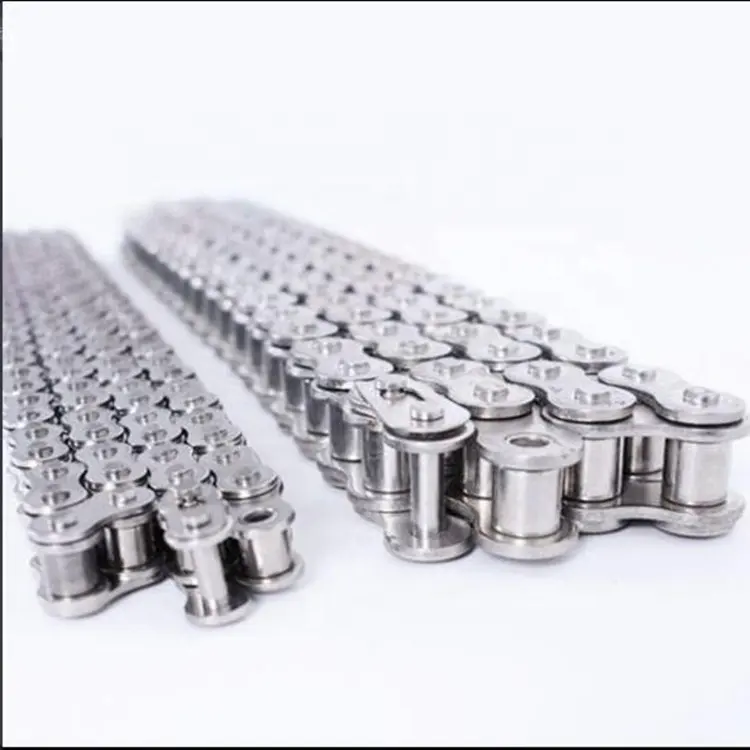
The pitch size of a transmission chain plays a crucial role in determining its performance and suitability for specific applications. The pitch size refers to the distance between adjacent chain links, typically measured from the center of one pin to the center of the next pin.
The pitch size of a transmission chain affects its performance in the following ways:
- Load Capacity: Chains with larger pitch sizes generally have higher load capacities. A larger pitch size allows for larger components, such as pins and rollers, which can withstand higher forces and transmit more power.
- Speed Capability: The pitch size also affects the chain’s speed capability. Chains with smaller pitch sizes are typically designed for higher speeds, as they offer smoother engagement with the sprockets and reduced inertia.
- Wear and Fatigue Resistance: Smaller pitch sizes distribute the load over more contact points, reducing the stress on individual components. This can improve wear resistance and increase the chain’s fatigue life.
- Compactness and Space Limitations: In applications where space is limited, smaller pitch chains are preferred as they allow for a more compact design.
It’s important to note that the selection of the appropriate pitch size depends on the specific application requirements, including the expected load, speed, and available space. Different pitch sizes are available to accommodate a wide range of applications, from light-duty to heavy-duty machinery.


editor by CX 2024-04-04