
Master the engineering formulas for sprocket tooth count calculation — with worked examples, standard ratio tables, and guidance on optimizing tooth count for wear life and smooth operation.
Why Tooth Count Selection Matters
The number of teeth on a sprocket determines the speed ratio, the chain wrap angle, the chordal action magnitude, and ultimately the service life of the entire chain drive system. Specifying too few teeth on the driver increases the articulation angle per pitch, amplifying velocity fluctuations and accelerating chain wear. Specifying too many teeth on the driven sprocket increases cost, weight, and the overall system footprint without delivering proportional performance gains. Getting the tooth count right is one of the most impactful decisions in chain drive sprocket system design.
This article provides the standard formulas, practical constraints, and worked examples that enable engineers to calculate the correct tooth count for both the driving and driven sprockets in a single-stage chain drive. The same principles apply whether you are designing a new system or verifying an existing installation for a replacement sprocket order.
The Basic Speed Ratio Formula
Sprocket Tooth Count Calculation
Motor: 1,450 RPM, Required output: 145 RPM, Ratio: 10:1
Use 2 stages: Stage 1 = 17T:54T (3.18:1), Stage 2 = 17T:54T (3.18:1). Combined ratio: 10.1:1
Motor: 1,000 RPM, Required output: 250 RPM, Ratio: 4:1
Single stage achievable. 21T driver gives excellent wrap angle and smooth operation.
Motor: 720 RPM, Required output: 120 RPM, Ratio: 6:1
Within single-stage range. 19T driver balances wear life with compact design.
The speed ratio of a chain drive equals the ratio of driven sprocket teeth to driver sprocket teeth: i = N2 / N1. This also equals the inverse ratio of the shaft speeds: i = n1 / n2. For example, if you need to reduce a motor speed of 1,450 RPM to 290 RPM, the required ratio is 1450/290 = 5:1. Choose a driver sprocket with 19 teeth and the driven sprocket needs 19 × 5 = 95 teeth.
The tooth count must be a whole number. If the calculated driven tooth count is not an integer, adjust either the driver tooth count or accept a slightly different output speed. For precision applications where exact speed is critical, iterate through different driver tooth counts (17, 19, 21, 23, 25) and calculate the actual output speed for each to find the combination that minimizes speed error.
Recommended Tooth Count Ranges
For the driving sprocket, the recommended range is 17 to 25 teeth. Fewer than 17 teeth increases chordal action — the cyclic speed variation inherent in chain-sprocket engagement — which produces vibration, noise, and accelerated wear. Each tooth engagement on a 13-tooth sprocket causes a speed fluctuation of approximately 5.7%, compared to 1.7% on a 21-tooth sprocket. More teeth means smoother operation and longer chain life.
For the driven sprocket, the practical maximum is approximately 120 teeth for standard roller chains. Beyond 120 teeth, the sprocket diameter becomes excessively large, the chain wrap angle on the driver becomes insufficient, and the sprocket itself becomes expensive to manufacture and difficult to balance. If the speed ratio requires more than 120 teeth on the driven sprocket, split the reduction into two stages with two separate chain drives, each operating within the recommended tooth count range.
Odd vs Even Tooth Counts
Using an odd number of teeth on at least one sprocket in the pair provides a wear advantage. When the driver has an odd tooth count and the driven has an even count (or vice versa), each chain link engages with different teeth on successive revolutions, distributing wear more evenly across all teeth. If both sprockets have even tooth counts, the same links always engage the same teeth, concentrating wear on specific tooth pairs and shortening both chain and sprocket life.
This principle is particularly important for drives that operate at moderate to low speeds where each tooth carries the load for a longer duration per revolution. At high speeds, the rapid cycling through all teeth provides natural wear distribution regardless of odd/even selection. For maximum service life on slow-speed, heavy-load drives, specify an odd number of teeth on the smaller sprocket.
Chain Length Calculation from Tooth Counts
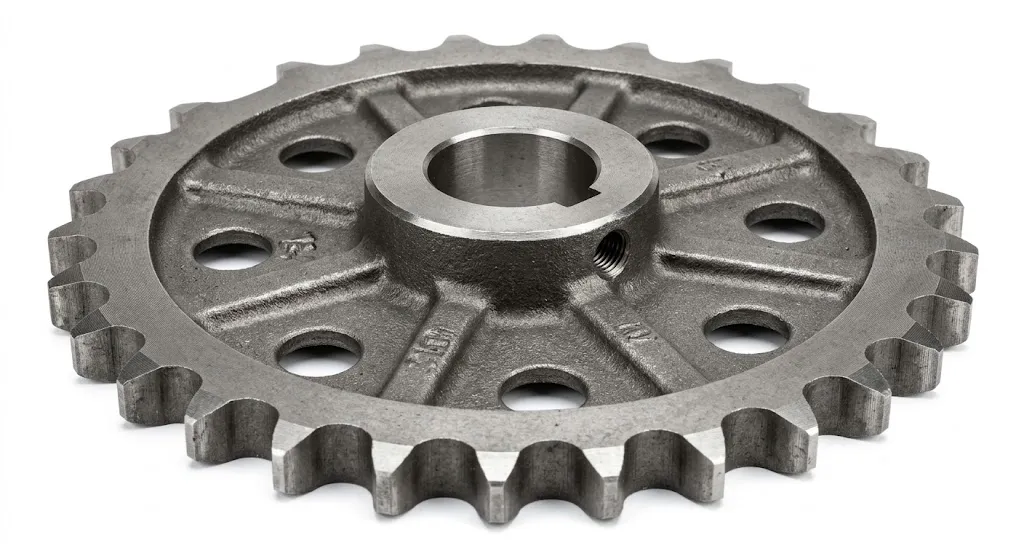
Once both tooth counts are established, the required chain length in pitches is calculated as: L = 2C/P + (N1+N2)/2 + P(N2-N1)²/(4π²C), where C is the center distance between shaft centers, P is the chain pitch, and N1/N2 are the sprocket tooth counts. Round the result up to the nearest even integer. For a drive with 21T and 84T sprockets at 15.875 mm pitch and 750 mm center distance, the formula yields approximately 148 pitches.
If the calculated chain length requires adjustment, modify the center distance rather than the tooth counts. Center distance is typically adjustable through motor mounting slots or idler sprocket positioning, while tooth counts are fixed by the speed ratio requirement. Maintain enough adjustment range to accommodate chain elongation over the service life — typically 1.5% to 3% of the total chain length.
Why Choose Hangzhou Ever-Power as Your Supplier
Selecting a sprocket chain supplier is a decision that extends far beyond unit price. Delivery reliability, dimensional consistency across production batches, willingness to support OEM customization, and responsive after-sales technical backing all factor into the total cost of ownership. Hangzhou Ever-Power Sprocket Chain Co., Ltd. has built its reputation over decades by treating each of these factors as a baseline expectation rather than a premium add-on.
From raw steel blanking through heat treatment, shot peening, and final assembly, every production stage happens under one roof in Hangzhou — eliminating the quality drift that plagues multi-vendor supply chains.
Non-standard bore sizes, special tooth profiles, proprietary surface coatings, and unique attachment configurations are routine production orders — not special projects that require months of back-and-forth negotiation.
Every batch undergoes tensile testing, Rockwell hardness verification, dimensional inspection with CMM equipment, and pre-shipment elongation checks before products leave the factory floor.
Products ship to over 60 countries with packaging rated for ocean freight and documentation compliant with EU, North American, and Southeast Asian import regulations.
Frequently Asked Questions
Get in Touch with Our Engineering Team
Whether you need a standard catalog chain or a fully custom-engineered solution, our technical sales team is ready to assist with specification, pricing, and logistics.
Company
Hangzhou Ever-Power Sprocket Chain Co., Ltd.
Address
Shenhua Road, Hangzhou, China
Phone
+86-571-88220653