
A practical engineering guide for matching sprocket chain specifications to your machinery requirements — covering load calculations, environment factors, and material selection.
Why Proper Chain Selection Impacts Total Cost of Ownership
Choosing the right sprocket chain is not simply a matter of matching a pitch number from a catalog. A chain that is technically compatible with your sprocket teeth can still fail prematurely if the operating load, speed, or environment was not factored into the selection. The resulting downtime, emergency replacement costs, and secondary damage to bearings and shafts almost always exceeds the price difference between the correct chain and the one that was ordered hastily. Industrial procurement teams that invest an extra hour in specification work consistently report lower annual maintenance budgets.
This guide walks through the selection process from initial load analysis to final supplier qualification. Whether you are designing a new conveyor line or replacing worn chains on existing equipment, the methodology applies equally. Every recommendation here reflects current ANSI B29.1 and ISO 606 engineering practice as applied to real-world operating conditions in factories, farms, and processing plants around the world.
Step 1: Define the Operating Load and Speed
Start with the driven load. Calculate the total force the chain must transmit by dividing the required power (in kW or HP) by the sprocket rotational speed. For a conveyor carrying 5 kW at 120 RPM on a 17-tooth driving sprocket, the effective chain pull can be derived from standard power rating tables in your chain supplier’s catalog. Always apply a service factor — typically 1.0 to 1.7 — to account for shock loading, start-stop cycling, or abrasive particulate in the environment.
Speed Constraints
Maximum allowable chain speed depends on pitch size. Smaller-pitch chains can operate at higher linear speeds because the polygon effect produces less vibration per revolution. An ANSI 40 chain running on a 21-tooth sprocket handles up to 1,200 RPM comfortably, while an ANSI 80 chain on the same tooth count should not exceed 600 RPM. Exceeding these limits causes fatigue cracking in the link plates and can break the chain without warning.
Step 2: Select the Chain Pitch and Strand Count
Once the load and speed envelope is defined, consult the power rating tables provided by your roller chain supplier. These tables list the maximum transmittable power for each chain pitch at various sprocket speeds and tooth counts. If a single-strand (simplex) chain at a given pitch does not meet the required power, you have two options: move to the next larger pitch, or keep the same pitch and add strands. A duplex chain at 12.7 mm pitch carries roughly twice the power of a simplex chain at the same pitch.
In practice, choosing between a larger pitch and a multi-strand configuration comes down to sprocket availability, space constraints, and cost. Multi-strand chains require wider sprockets and more precise alignment, but they keep the overall system compact. Larger pitch chains need bigger sprockets with fewer teeth for the same speed ratio, which increases the polygon effect and produces more vibration. Discuss both options with your chain sprocket wholesale supplier to get accurate lead times and pricing for each approach.
Step 3: Evaluate the Operating Environment
The environment in which the chain operates determines the material grade and surface treatment required. Standard carbon steel chains perform well in dry, indoor applications with temperatures below 150 degrees Celsius. For food processing, pharmaceutical, and chemical plants where washdown cycles and corrosive substances are present, stainless steel sprocket chains in SUS304 or SUS316 grade are the appropriate specification. SUS316 provides superior resistance to chloride-containing solutions and is the preferred choice for marine and coastal installations.
Temperature extremes also influence selection. At sustained temperatures above 200 °C, standard lubricants break down and special high-temperature greases or dry-film coatings are required. At sub-zero temperatures, standard carbon steel becomes brittle; cold-weather chains use alloy steels with higher impact toughness at -40 °C and below. Document the full temperature range — including startup conditions — before finalizing your chain specification.
Step 4: Match Chain and Sprocket Set Specifications
Application-to-Chain Type Selection Matrix
| Application | Recommended Type | Pitch Range | Material | Strand |
|---|---|---|---|---|
| Light conveyor | Double Pitch | 50.8 mm | Carbon steel | Simplex |
| Heavy conveyor | Standard Roller | 15.875 – 25.4 mm | Carbon / Alloy | Duplex |
| Food processing | Standard Roller | 9.525 – 15.875 mm | SUS304 / SUS316 | Simplex |
| Mining / cement | Heavy Duty | 25.4 – 38.1 mm | Alloy steel | Triplex |
| Packaging line | Precision Roller | 9.525 – 12.7 mm | Carbon steel | Simplex |
| Agricultural | Standard Roller | 15.875 – 25.4 mm | Carbon + Zinc | Simplex / Duplex |
| Motorcycle | O-Ring Roller | 12.7 mm | Alloy steel | Simplex |
| Selection based on typical operating parameters. Confirm with detailed load and speed analysis for your specific application. | ||||
Once the chain type, pitch, and strand count are established, specify the sprocket parameters. The driving sprocket typically has 17 to 25 teeth — fewer teeth increase chain articulation angle per pitch and accelerate wear, while more teeth distribute the load more evenly but increase the sprocket diameter. The driven sprocket tooth count determines the speed ratio. For a chain and sprocket set to perform optimally, both components must be manufactured to the same standard and the same pitch.
Bore size is the next critical parameter. Standard catalog sprockets are available with pilot bores (undersized for machining to your shaft diameter) or finished bores with keyway. Specify the bore tolerance — H7 is standard for precision fits — and confirm whether a set screw, keyway, or taper-lock hub attachment is required. Mismatched bore dimensions lead to wobble, vibration, and accelerated chain wear.
Step 5: Request Samples and Validate
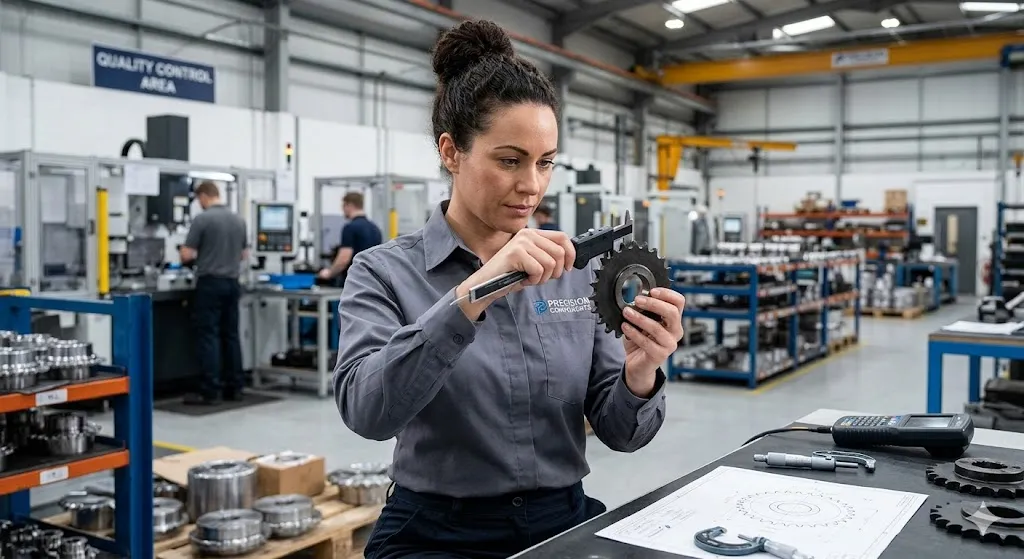
Before committing to a bulk order, request pre-production samples from your shortlisted heavy duty roller chain suppliers. Measure the pitch accuracy across 10 consecutive links using a vernier caliper or chain wear gauge. Verify roller diameter, pin diameter, and inner width against the catalog specifications. Install the sample on your actual equipment and run it under realistic load conditions for at least 48 hours, checking for abnormal noise, temperature rise at the sprocket teeth, and any visible chain elongation.
Document all sample test results. This data becomes the benchmark for incoming quality inspection when full production orders arrive. Establishing acceptance criteria upfront — pitch tolerance within 0.15%, hardness within 2 HRC points of specification, elongation below 0.5% after break-in — prevents disputes and returns down the line. A reliable roller chain supplier will welcome this level of scrutiny because it aligns buyer and manufacturer expectations from the start.
Why Choose Hangzhou Ever-Power as Your Supplier
Selecting a sprocket chain supplier is a decision that extends far beyond unit price. Delivery reliability, dimensional consistency across production batches, willingness to support OEM customization, and responsive after-sales technical backing all factor into the total cost of ownership. Hangzhou Ever-Power Sprocket Chain Co., Ltd. has built its reputation over decades by treating each of these factors as a baseline expectation rather than a premium add-on.
From raw steel blanking through heat treatment, shot peening, and final assembly, every production stage happens under one roof in Hangzhou — eliminating the quality drift that plagues multi-vendor supply chains.
Non-standard bore sizes, special tooth profiles, proprietary surface coatings, and unique attachment configurations are routine production orders — not special projects that require months of back-and-forth negotiation.
Every batch undergoes tensile testing, Rockwell hardness verification, dimensional inspection with CMM equipment, and pre-shipment elongation checks before products leave the factory floor.
Products ship to over 60 countries with packaging rated for ocean freight and documentation compliant with EU, North American, and Southeast Asian import regulations.
Common Selection Mistakes to Avoid
The most frequent error is selecting a chain based solely on pitch compatibility without verifying the power rating. A chain that physically fits the sprocket may be operating at 90% of its rated capacity, leaving no margin for shock loads or startup torque spikes. The second common mistake is ignoring the environment — running a standard carbon steel chain in a washdown area because it is cheaper than stainless steel, only to replace it three times in the period a stainless chain would have lasted without issue.
A third pitfall involves mixing standards. ANSI and ISO chains have different roller diameters at the same nominal pitch, so an ANSI chain on an ISO sprocket creates a mismatch that accelerates tooth and roller wear. Always confirm that the chain and sprocket share the same standard designation. Finally, avoid the temptation to over-tension a new chain to compensate for expected elongation. Proper initial tension — 2% to 4% sag relative to center distance — protects bearings and extends chain life from the first hour of operation.
Frequently Asked Questions
Get in Touch with Our Engineering Team
Whether you need a standard catalog chain or a fully custom-engineered solution, our technical sales team is ready to assist with specification, pricing, and logistics.
Company
Hangzhou Ever-Power Sprocket Chain Co., Ltd.
Address
Shenhua Road, Hangzhou, China
Phone
+86-571-88220653