
Step-by-step procedures for mounting sprockets, threading chain, setting alignment, and adjusting tension — with the most common installation mistakes identified and explained.
Pre-Installation Checklist
Before any component is mounted, inspect all parts for shipping damage, verify that chain and sprocket specifications match, and confirm that shafts, bearings, and mounting surfaces are in serviceable condition. A new chain drive sprocket system installed on a worn shaft or misaligned bearing housing will underperform from the first hour. Check shaft runout with a dial indicator — total indicated runout should not exceed 0.05 mm for precision drives — and verify keyway dimensions against the sprocket bore drawing.
Clean the shaft, bore, and key surfaces to remove preservative coatings, rust, and debris. Lay out all components — sprockets, chain, connecting link, keys, set screws — and compare them against the bill of materials. Missing or incorrect parts discovered after partial assembly waste far more time than a five-minute pre-installation check.
Mounting the Sprockets
Slide the driving sprocket onto the motor shaft and align it axially with the driven sprocket position. For keyed bores, the key should fit snugly in both the shaft keyway and the sprocket keyway without excessive clearance. Tighten set screws to the torque specified in the sprocket manufacturer’s datasheet — typically 8 to 25 Nm depending on bore size. For taper-lock hubs, assemble the bushing into the sprocket, slide the assembly onto the shaft, and tighten the cap screws progressively in a star pattern to ensure even clamping.
Confirm the sprocket bore tolerance before installation. A standard finished bore is machined to H7 tolerance, which provides an interference-free fit with standard shaft tolerance classes. If the sprocket wobbles on the shaft, check for bore oversize, keyway damage, or shaft undersize. Wobble as small as 0.1 mm at the tooth tip translates into cyclic chain loading that accelerates wear.
Threading and Connecting the Chain
Drape the chain over both sprockets, ensuring the open ends meet on the slack span (the lower span in a horizontal drive, or the non-loaded span in a vertical drive). Connect the ends using the supplied connecting link — either a clip-type or cotterpin-type link. The closed end of the spring clip must face the direction of chain travel so that friction holds the clip on rather than pushing it off. For press-fit connecting links, use a chain press tool to seat the pins fully into the outer plate; hammering can damage the plate or deform the pin head.
If the chain is a multi-strand configuration, verify that all strands are parallel and the connecting link aligns all strands simultaneously. A misaligned connecting link on a duplex or triplex chain creates a hard point that causes the chain to lurch as it passes over the sprocket, producing an audible click-click pattern and localizing stress at the connecting joint.
Setting Sprocket Alignment
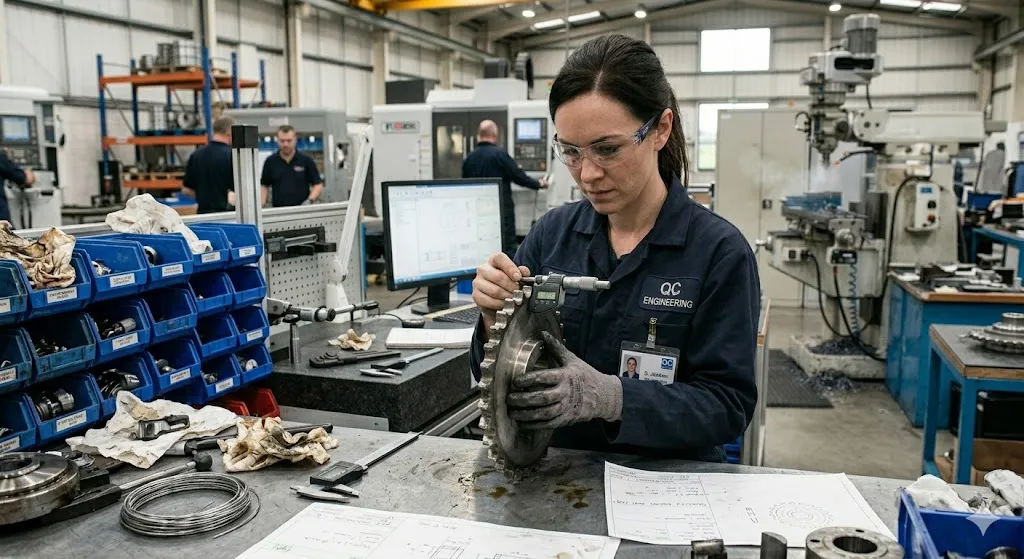
Sprocket alignment is the most frequently overlooked installation step and one of the leading causes of premature chain wear. Place a precision straight edge across the faces of both sprockets. On a properly aligned drive, the straight edge contacts all four face edges (two per sprocket) simultaneously with no visible gap. The maximum allowable misalignment is 0.5 degrees angular or 3 mm per meter of center distance for parallel offset.
Laser alignment systems provide higher accuracy and are recommended for drives operating above 500 RPM or with center distances exceeding 1.5 meters. After alignment, recheck by rotating the shafts one full turn — thermal expansion, bearing clearance, and shaft runout can create alignment variations that only appear at certain angular positions. Tighten all motor mounting bolts and check alignment one final time after torquing, as bolt tightening can shift the motor position slightly.
Adjusting Chain Tension
Misalignment Impact on Chain Wear Rate
With alignment confirmed, adjust the motor mounting position (or idler sprocket/tensioner) to set chain slack. The correct mid-span sag on the slack side is 2% to 4% of the center distance. For a 1,000 mm center-to-center drive, the chain should deflect 20 to 40 mm when pressed firmly by hand at the midpoint of the slack span. Vertical drives require less sag — approximately 1% — because gravity acts on the entire slack span.
Lock the motor or tensioner position after adjustment. Recheck tension after the first 24 hours of operation, as new chains undergo a break-in elongation of approximately 0.3% to 0.5% that loosens the initial setting. Note the baseline tension reading for future reference so that gradual wear-related elongation can be tracked quantitatively over the chain’s service life.
Common Installation Mistakes to Avoid
The first and most damaging mistake is skipping alignment verification. Chains installed on misaligned sprockets begin wearing from the first revolution, and the wear pattern — one-sided plate thinning — compounds until the chain fails or derails. The second mistake is using a hammer to seat connecting link pins instead of a proper chain press. Hammer impacts deform the pin head and crack the outer plate, creating a stress riser that leads to fatigue failure at the connecting link.
Over-tensioning is the third common error. Technicians sometimes tighten the chain beyond specification in an attempt to eliminate all visible sag, not realizing that zero sag overloads every bearing in the system. The fourth mistake is neglecting to lubricate the chain before the first start. Factory preservative coatings are not lubricants — they protect against corrosion during shipping but provide no pin-bushing lubrication. Apply the specified chain oil to the entire chain before engaging the drive for the first time.
Why Choose Hangzhou Ever-Power as Your Supplier
Selecting a sprocket chain supplier is a decision that extends far beyond unit price. Delivery reliability, dimensional consistency across production batches, willingness to support OEM customization, and responsive after-sales technical backing all factor into the total cost of ownership. Hangzhou Ever-Power Sprocket Chain Co., Ltd. has built its reputation over decades by treating each of these factors as a baseline expectation rather than a premium add-on.
From raw steel blanking through heat treatment, shot peening, and final assembly, every production stage happens under one roof in Hangzhou — eliminating the quality drift that plagues multi-vendor supply chains.
Non-standard bore sizes, special tooth profiles, proprietary surface coatings, and unique attachment configurations are routine production orders — not special projects that require months of back-and-forth negotiation.
Every batch undergoes tensile testing, Rockwell hardness verification, dimensional inspection with CMM equipment, and pre-shipment elongation checks before products leave the factory floor.
Products ship to over 60 countries with packaging rated for ocean freight and documentation compliant with EU, North American, and Southeast Asian import regulations.
Frequently Asked Questions
Get in Touch with Our Engineering Team
Whether you need a standard catalog chain or a fully custom-engineered solution, our technical sales team is ready to assist with specification, pricing, and logistics.
Company
Hangzhou Ever-Power Sprocket Chain Co., Ltd.
Address
Shenhua Road, Hangzhou, China
Phone
+86-571-88220653