
Learn the correct procedures for measuring chain pitch, roller diameter, inner width, and overall length — with practical guidance on identifying ANSI and ISO chain numbers from field measurements.
Why Accurate Chain Measurement Matters
Ordering a replacement sprocket chain based on an approximate measurement or a faded part number is one of the fastest routes to a mismatched drive system. If the measured pitch is off by even half a millimeter, the chain will seat incorrectly on the sprocket teeth, producing accelerated wear, abnormal noise, and shortened service life. Engineers responsible for maintaining chain drive sprocket systems need a reliable, repeatable measurement method that eliminates guesswork and maps directly to standard chain designations.
This guide covers the five critical dimensions you must capture, the tools required, and the step-by-step process for converting raw measurements into an ANSI or ISO chain number. Whether you are dealing with a single worn chain or cataloging an entire plant’s drive inventory, these procedures ensure you order exactly the right replacement every time.
Tools You Will Need
Precision measurement of roller chain requires a small set of readily available instruments. A digital vernier caliper with a resolution of 0.02 mm or better is the primary tool — mechanical dial calipers also work but are slower to read in poor lighting. A steel rule or tape measure graduated in millimeters serves as a backup for pitch measurement across longer spans. You will also need a chain wear gauge (also called a chain checker) if you intend to assess elongation simultaneously with sizing.
For multi-strand chains, a depth micrometer or second caliper is useful for measuring overall assembly width. Keep a notepad or digital form handy to record each dimension immediately — memory errors account for a surprising number of incorrect chain orders. If the chain is still installed on the machine, you may need a flashlight and a mirror for reading dimensions on the slack-side span where access is limited.
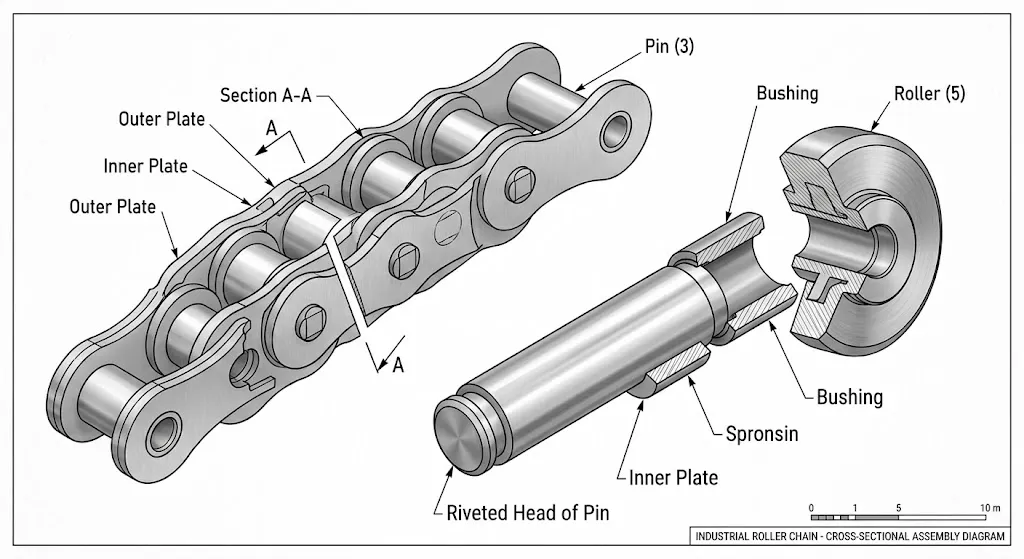
How to Measure Chain Pitch Accurately
Chain Dimension Quick Reference
Pin center to adjacent pin center
Range: 6.35 – 76.2 mm
Outer diameter of the chain roller
Range: 3.30 – 47.63 mm
Gap between inner link plates
Range: 3.18 – 47.63 mm
Thickness of outer link plate
Range: 0.8 – 7.9 mm
Overall pin length (defines strand width)
Range: Strand-dependent
Chain pitch is the single most important dimension. It defines which sprocket the chain will fit. To measure pitch, place your caliper jaws on the center of one pin and measure to the center of the immediately adjacent pin. Because pin centers are difficult to locate precisely on an assembled chain, the preferred method is to measure across 10 consecutive pins (which spans 10 pitches) and divide the result by 10. This averaging technique reduces the impact of individual measurement error and accounts for any wear-related elongation.
For example, if 10 pitches measure 127.3 mm, the average pitch is 12.73 mm. The nominal pitch of an ANSI 40 chain is 12.700 mm, so the chain is an ANSI 40 that has elongated by approximately 0.24% — well within serviceable range. If the 10-pitch measurement exceeds the nominal by more than 3%, the chain has reached its wear limit and should be replaced rather than simply identified and reordered.
How to Measure Roller Diameter and Inner Width
Roller diameter is measured by placing the caliper across the outer surface of one roller. Ensure the caliper contacts the roller at its widest point — not on the edge where the roller meets the link plate. Record the reading to the nearest 0.01 mm. This dimension is critical because ANSI and ISO chains at the same pitch often have different roller diameters, and using the wrong chain on a sprocket causes the rollers to ride incorrectly in the tooth gaps.
Inner width — the gap between the two inner link plates — is measured by inserting the caliper jaws between the plates at the center of an inner link. Do not force the caliper; a light contact measurement is sufficient. If the chain is heavily worn or corroded, clean the measurement area with a wire brush first. Inner width determines whether the chain can seat properly on the sprocket tooth; a chain that is too narrow or too wide for the tooth creates a lateral mismatch that accelerates both chain and sprocket wear.
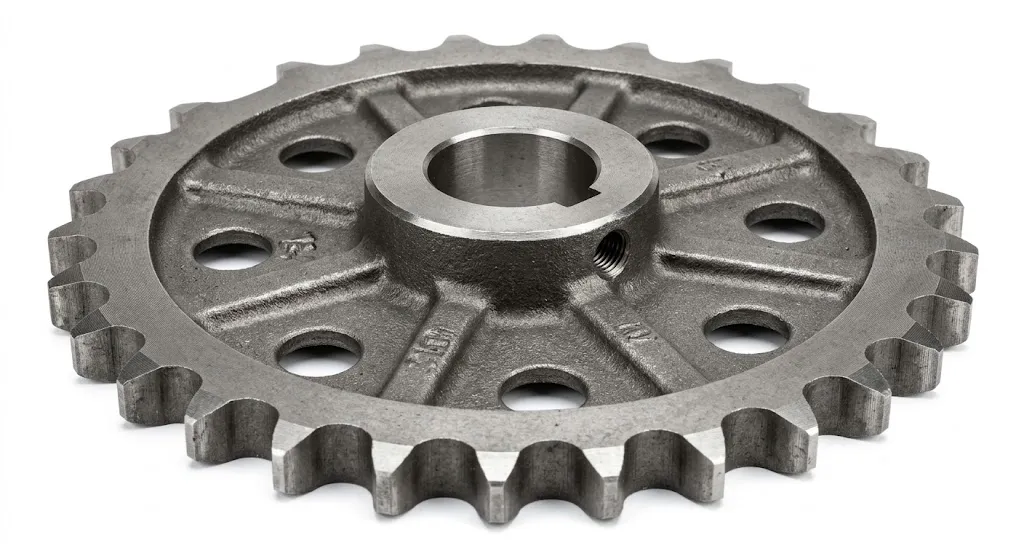
Identifying the Chain Standard: ANSI vs ISO Cross-Reference
Once you have pitch, roller diameter, and inner width, cross-reference these three dimensions against the ANSI B29.1 and ISO 606 tables. An ANSI 40 chain has a pitch of 12.700 mm, roller diameter of 7.95 mm, and inner width of 7.85 mm. The closest ISO equivalent, 08B, shares the 12.700 mm pitch but has a roller diameter of 8.51 mm and inner width of 7.75 mm. These differences are small enough to be missed by casual measurement but large enough to cause premature wear if mismatched with the wrong sprocket.
| ANSI No. | ISO No. | Pitch (mm) | Roller Dia. (mm) | Inner Width (mm) |
|---|---|---|---|---|
| 25 | 04C | 6.350 | 3.30 | 3.18 |
| 35 | 06B | 9.525 | 5.08 | 4.78 |
| 40 | 08A | 12.700 | 7.95 | 7.85 |
| 50 | 10A | 15.875 | 10.16 | 9.40 |
| 60 | 12A | 19.050 | 11.91 | 12.57 |
| 80 | 16A | 25.400 | 15.88 | 15.75 |
| 100 | 20A | 31.750 | 19.05 | 18.90 |
| ANSI B29.1 and ISO 606 dimensions for standard simplex roller chains. Verify roller diameter to confirm which standard applies. | ||||
Counting Links and Calculating Chain Length
Chain length is specified in number of pitches (links), not in meters or feet, when ordering from a sprocket chain manufacturer. Count the total number of outer link plates visible on one side of the chain — each outer plate corresponds to one pitch. Alternatively, if the chain is removed from the machine, lay it flat and count the pin locations. An even number of pitches allows the chain to be joined with a standard connecting link; an odd number requires an offset link, which is a weak point and should be avoided when possible.
The required chain length for a new installation is calculated from the center distance between sprockets and the tooth counts of both sprockets. The standard formula yields length in pitches: L = 2C/P + (N1+N2)/2 + P(N2-N1)²/(4π²C), where C is center distance, P is pitch, and N1/N2 are tooth counts. Round up to the nearest even number. Most chain drive sprocket applications use chain lengths between 60 and 200 pitches.
Why Choose Hangzhou Ever-Power as Your Supplier
Selecting a sprocket chain supplier is a decision that extends far beyond unit price. Delivery reliability, dimensional consistency across production batches, willingness to support OEM customization, and responsive after-sales technical backing all factor into the total cost of ownership. Hangzhou Ever-Power Sprocket Chain Co., Ltd. has built its reputation over decades by treating each of these factors as a baseline expectation rather than a premium add-on.
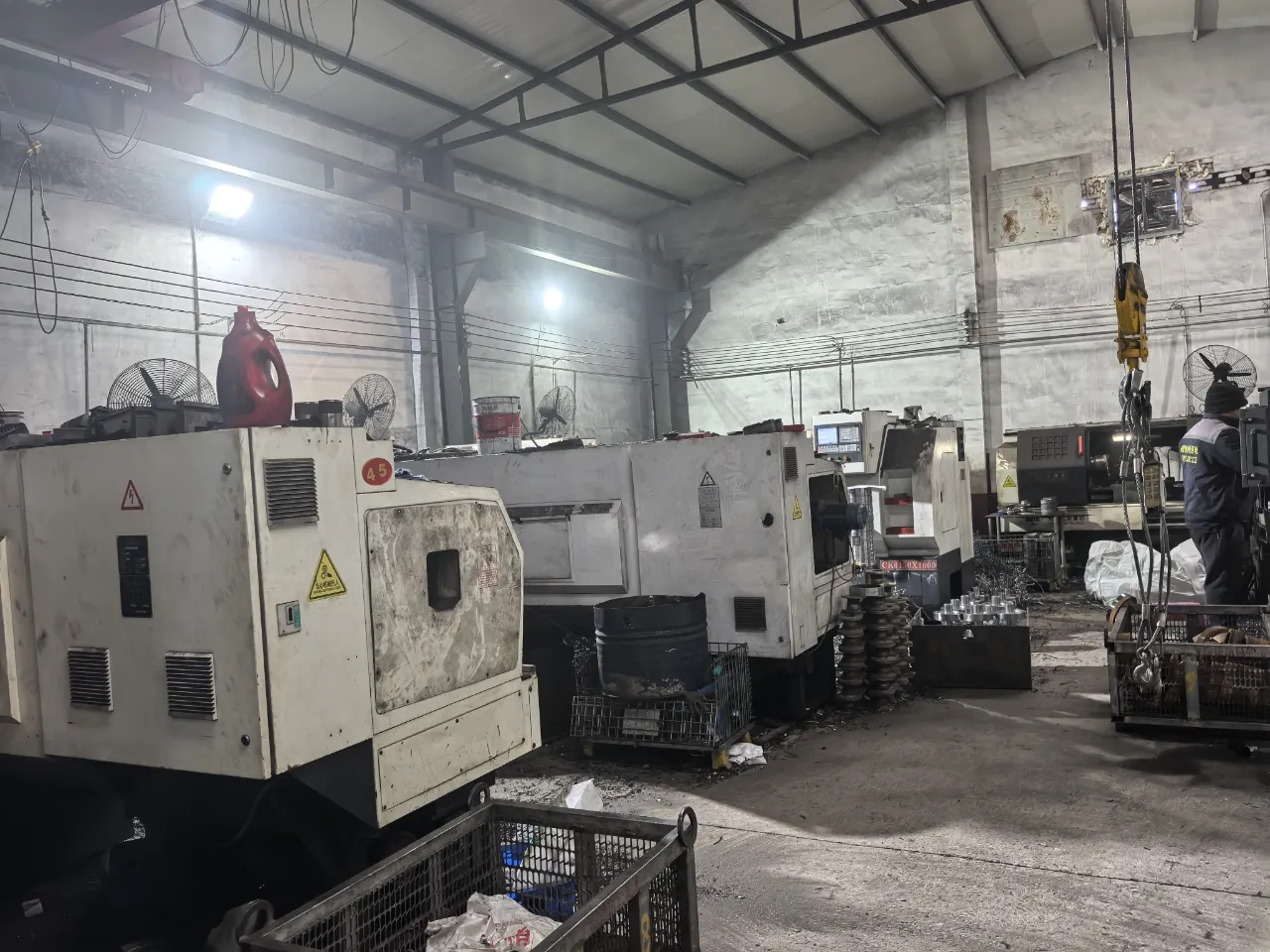
From raw steel blanking through heat treatment, shot peening, and final assembly, every production stage happens under one roof in Hangzhou — eliminating the quality drift that plagues multi-vendor supply chains.
Non-standard bore sizes, special tooth profiles, proprietary surface coatings, and unique attachment configurations are routine production orders — not special projects that require months of back-and-forth negotiation.
Every batch undergoes tensile testing, Rockwell hardness verification, dimensional inspection with CMM equipment, and pre-shipment elongation checks before products leave the factory floor.
Products ship to over 60 countries with packaging rated for ocean freight and documentation compliant with EU, North American, and Southeast Asian import regulations.
Common Measurement Errors and How to Avoid Them
The most common error is measuring pitch on a worn chain and treating the elongated measurement as the nominal value. Always measure across 10 pitches and compare against standard tables, not against a single-pitch reading from a worn chain. The second error is confusing ANSI and ISO chains that share the same pitch — without checking roller diameter, the wrong chain gets ordered and installed, causing quiet but rapid wear that only becomes visible after several hundred hours of operation.
A third mistake involves measuring inner width on a chain with debris or corrosion between the plates. Even a thin layer of rust or compacted dust can add 0.3 to 0.5 mm to the reading, pushing the measurement into the next chain category. Clean the measurement zone thoroughly before placing the caliper. Finally, avoid estimating strand count from a photograph or memory — physically confirm whether the chain is simplex, duplex, or triplex before ordering, as multi-strand chains require matched-width sprockets.
Frequently Asked Questions
Get in Touch with Our Engineering Team
Whether you need a standard catalog chain or a fully custom-engineered solution, our technical sales team is ready to assist with specification, pricing, and logistics.
Company
Hangzhou Ever-Power Sprocket Chain Co., Ltd.
Address
Shenhua Road, Hangzhou, China
Phone
+86-571-88220653