A complete technical overview of sprocket chain systems — covering construction, working principles, classification standards, and real-world industry uses for engineers and procurement professionals.
Understanding the Basics of Sprocket Chain Systems
A sprocket chain system consists of two primary components working in tandem: a toothed wheel known as the sprocket, and a roller chain that wraps around it. When the driving sprocket rotates, the chain meshes with each tooth in sequence, transferring rotational energy to a second sprocket on a separate shaft. This mechanism converts torque into linear or rotational motion with virtually zero slippage, making it one of the most reliable methods of mechanical power transmission available to engineers across dozens of industries.
Unlike belt drives that depend on friction, a chain drive sprocket system uses positive engagement between chain rollers and sprocket teeth. Each link seats precisely into the corresponding tooth gap, ensuring consistent speed ratios and eliminating the creep common in belt-driven alternatives. This direct engagement allows sprocket chain assemblies to handle substantially higher loads at lower speeds — a critical advantage in heavy industrial environments.
Core Functions in Mechanical Power Transmission
The primary function of a power transmission chain is to deliver rotational force from a motor to a driven component at a predetermined speed ratio. The chain connects driving and driven sprockets, and the ratio of teeth between them determines speed reduction and torque multiplication. A properly installed and lubricated chain operates at efficiencies between 95% and 98%, placing it among the most efficient drive options outside of direct coupling.
Beyond torque transfer, sprocket chains synchronize the rotation of multiple shafts in multi-sprocket configurations, accommodate moderate center distances far greater than gear trains, and tolerate misalignment and shock loading that would destroy a direct gear mesh. This versatility explains their dominance across industries from food processing to mining.
How a Sprocket Chain Works: Mechanics of Motion Transfer
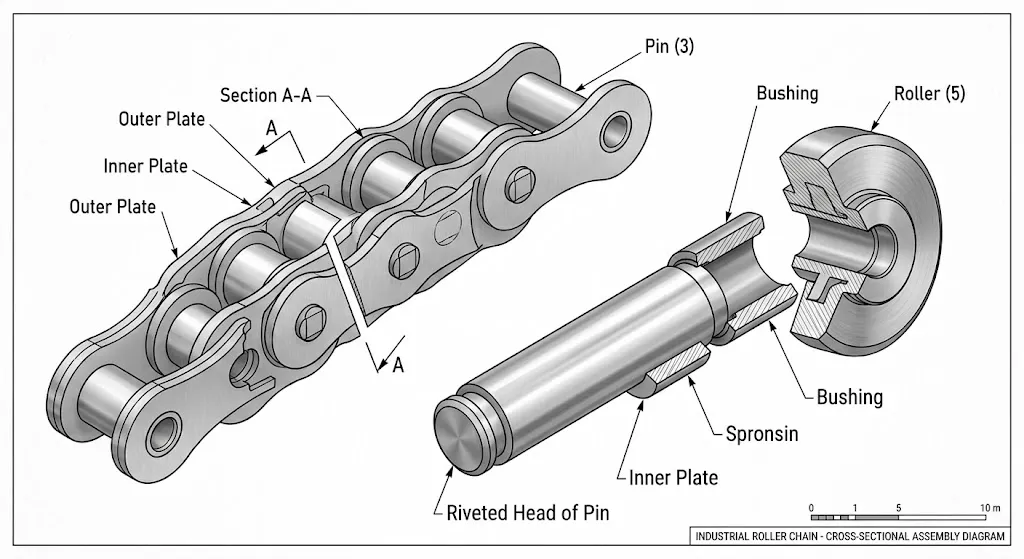
The working principle relies on the polygon effect — the chain wraps around the sprocket as straight chords rather than a smooth arc. Each roller sits in the trough between two adjacent teeth, and as the sprocket rotates, it lifts each roller and advances the chain by one pitch length. The chain comprises alternating inner and outer link plates connected by hardened steel pins with bushings and rollers for reduced friction.
Strand Configuration
Standard roller chains come in simplex (single-strand), duplex (double-strand), and triplex (triple-strand) configurations. Adding strands increases load capacity proportionally — a duplex chain handles approximately twice the load of a simplex chain at identical pitch. Engineers specify multi-strand configurations when the load exceeds single-strand capacity at a reasonable pitch size.
Types of Sprocket Chains by Design and Standard
| Chain Type | Load | Speed | Corrosion | Cost Eff. |
|---|---|---|---|---|
| Standard Roller | High | High | Low | Excellent |
| Stainless Steel | Medium | Medium | Excellent | Moderate |
| Duplex / Triplex | Very High | Medium | Low | Good |
| Double Pitch | Medium | High | Low | Excellent |
| Heavy Duty | Very High | Low | Low | Good |
| Motorcycle | Medium | Very High | Medium | Good |
| Relative ratings within standard pitch ranges. Actual performance varies by pitch, material, and conditions. | ||||
Standard carbon steel roller chains manufactured to ANSI B29.1 or ISO 606 suit most applications below 150 °C with minimal corrosion. Stainless steel variants (SUS304/SUS316) serve washdown and chemical environments. Duplex and triplex chains multiply load capacity; double pitch conveyor chains suit long-run, light-load systems; heavy duty chains serve mining and cement plants.
Industry Applications for Sprocket Chains
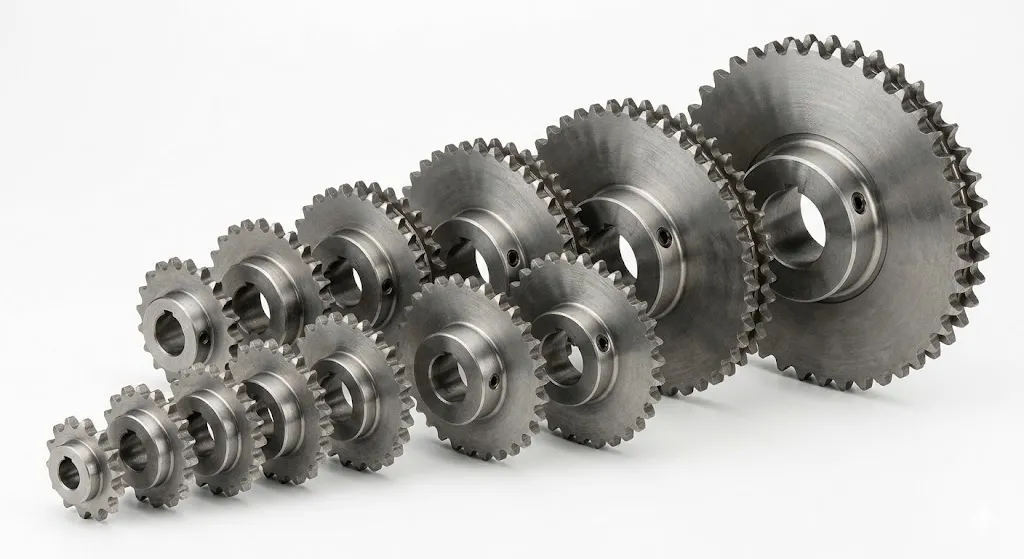
The industrial sprocket is a standard component across food processing (stainless steel, HACCP-compliant), mining (heavy duty, shock-resistant), agriculture (zinc-coated, dust-tolerant), automotive manufacturing (precision roller for exact cycle times), packaging (tight-tolerance simplex), cement (extended-pin heavy chains), material handling (double pitch and standard roller), motorcycle (lightweight high-tensile), wastewater treatment (stainless or nickel-plated), and energy generation (continuous-duty rated).
Selecting the right chain type for each industry requires matching the environmental conditions — temperature range, corrosion exposure, contamination level, load profile — to the chain’s material and construction. Working with an experienced sprocket chain manufacturer ensures the specification captures all relevant operating parameters.
Key Specifications Engineers Must Evaluate
| Specification | Description | Common Values |
|---|---|---|
| Chain Pitch | Pin-to-pin center distance | 6.35 mm (#25) to 76.2 mm (#240) |
| Roller Diameter | Affects tooth form and load distribution | 3.30 mm to 47.63 mm |
| Tensile Strength | Maximum load before failure, per strand | 3.6 kN (#25) to 530 kN (#240) |
| Number of Strands | Simplex / duplex / triplex | 1 / 2 / 3 |
| Material | Carbon, stainless (SUS304/316), alloy | Application-dependent |
| Sprocket Tooth Count | Determines speed ratio and wrap angle | 9T to 120T+ |
| Tolerances per ANSI B29.1 / ISO 606. Confirm bore tolerance (H7) when ordering finished-bore sprockets. | ||
Why Choose Hangzhou Ever-Power as Your Supplier
Selecting a sprocket chain supplier is a decision that extends far beyond unit price. Delivery reliability, dimensional consistency across production batches, willingness to support OEM customization, and responsive after-sales technical backing all factor into the total cost of ownership. Hangzhou Ever-Power Sprocket Chain Co., Ltd. has built its reputation over decades by treating each of these factors as a baseline expectation rather than a premium add-on.
From raw steel blanking through heat treatment, shot peening, and final assembly, every production stage happens under one roof in Hangzhou — eliminating the quality drift that plagues multi-vendor supply chains.
Non-standard bore sizes, special tooth profiles, proprietary surface coatings, and unique attachment configurations are routine production orders — not special projects that require months of back-and-forth negotiation.
Every batch undergoes tensile testing, Rockwell hardness verification, dimensional inspection with CMM equipment, and pre-shipment elongation checks before products leave the factory floor.
Products ship to over 60 countries with packaging rated for ocean freight and documentation compliant with EU, North American, and Southeast Asian import regulations.
Maintenance Essentials for Long-Lasting Performance
Over 60% of unplanned chain failures trace back to inadequate lubrication, and another 25% result from misalignment or incorrect tension. Lubricate every 200-500 hours, measure elongation across 10 pitches quarterly, check alignment with a straight edge or laser tool, and maintain 2-4% slack-span sag. Replacing both chain and sprockets together ensures proper meshing and full expected service life.
Frequently Asked Questions
Get in Touch with Our Engineering Team
Whether you need a standard catalog chain or a fully custom-engineered solution, our technical sales team is ready to assist with specification, pricing, and logistics.
Company
Hangzhou Ever-Power Sprocket Chain Co., Ltd.
Address
Shenhua Road, Hangzhou, China
Phone
+86-571-88220653